AI websites
The 12 Best AI Startup Websites of 2026, and Who Designed Them
Table of contents
AI products are hard to put on a web page. A coding agent works while the developer looks away, a voice model has no screen, and an inference cloud is a room full of servers the buyer will never see. Most AI startup websites fall back on a glowing orb and a line about the future of work.
The 12 sites below do better, and every one of them was designed by an agency or studio that says so in public. We checked each credit against the live site before publishing and linked the designer's own case study, so you can see who did the work before you shortlist anyone.
Quick answer: The best AI startup websites show the product finishing a real task on the homepage, whether that is an agent mid-task, a voice agent you can call or a dashboard full of believable data. Top examples are Cursor and Harvey by basement.studio, Hobbes and Writesonic by Bricx, Murf AI by Ramotion and Artisan by Phenomenon Studio. Webstacks (Fireworks AI), Baunfire (Lumana), Metalab (Crusoe), Pixel Point (Recraft) and Bricx (Camb.ai and Billdr) designed the rest.
Here are all 12 AI website examples side by side, with the studio that designed each one.
| # | Company | What it sells | What the site does well | Designed by | Clutch |
|---|---|---|---|---|---|
| 1 | Hobbes | AI product demo agent | Live demo in the hero and journey tabs from pre-sales to expansion | Bricx | 5.0 (32 reviews) |
| 2 | Cursor | AI coding agent | Mock desktop with an agent mid-task and a CLI window | basement.studio | Not in our directory |
| 3 | Writesonic | AI search visibility platform | AI visibility gauge in the hero and a competitor leaderboard | Bricx | 5.0 (32 reviews) |
| 4 | Harvey | Legal AI platform | Adoption dashboard for a made-up law firm | basement.studio | Not in our directory |
| 5 | Murf AI | Voice agents and TTS API | Voice agent cards you can call from the homepage | Ramotion | 4.9 (29 reviews) |
| 6 | Camb.ai | AI dubbing and localization | Lit globe with live audio tags moving between countries | Bricx | 5.0 (32 reviews) |
| 7 | Artisan | AI sales agent (AI BDR) | Campaign builder screen with the agent handing leads to a rep | Phenomenon Studio | 5.0 (51 reviews) |
| 8 | Fireworks AI | Inference and training platform | Calm editorial hero, customer logos and a priced model list | Webstacks | Not in our directory |
| 9 | Lumana | AI video security | Natural-language camera search and a live alert chain | Baunfire | 4.9 (32 reviews) |
| 10 | Crusoe | AI cloud and data centers | Factory film in the hero and a model hub with try buttons | Metalab | In our directory |
| 11 | Recraft | AI image models | V4 Styles launch page that works as a live demo | Pixel Point | Not in our directory |
| 12 | Billdr | AI operating system for contractors | Named AI workers in the menu and a customer video card | Bricx | 5.0 (32 reviews) |
How we picked
We started from more than 50 AI startup homepages and kept a site only when two things held:
- The designer is credited in public. The agency or studio names the project on its own case study or work page. Sites we liked but couldn't trace to a designer (ElevenLabs, Decagon, Granola and others) are out, and so are sites where the credited work no longer matches the live site.
- The page makes the AI concrete. A first-time visitor can tell what the product does in one scroll, because the page shows it working, lets you hear it or draws the system.
Each image shows the company's homepage, except Recraft, where the V4 Styles launch page is the credited work.
Who designed these sites
Five of the eight designers credited here are in our agency directory. Each card shows our score, the agency's Clutch rating and its minimum project size.
BricxOur score4.9 / 5Clutch5.0(32)Min project$25,000+Full profileClutch reviewsRamotionRamotion focused digital product design, development, visual brand identity, and UI/UX design for Fortune 500 companies and growing Silicon Valley startups.\n\n# 1 contributor of Swift on GitHub\n# 3 design team on Dribbble\n# 1 UX/UI and Web team on Bēhance\nOur score4.5 / 5Clutch4.9(29)Min project$50,000+Full profileClutch reviewsPhenomenon StudioOur score4.5 / 5Clutch5.0(51)Min project$10,000+Full profileClutch reviewsBaunfireBaunfire is a Silicon Valley digital creative agency. We are a team of designers, developers, strategists, and producers building elevated corporate websites for leading technology brands, B2B companies, and funded startups. Let\u0026#39;s work together to build something great — www.baunfire.com\n\nCore Services:\nB2B Marketing Websites\nWeb \u0026amp; UI/UX Design\nFront-End Web Development\nBraOur score4.2 / 5Clutch4.9(32)Min project$75,000+Full profileClutch reviewsMetalabWe make interfaces. We\u0026#39;re the team behind interfaces that billions of people click, tap, pinch, and zoom every day. You may not have known it at the time, but you’ve probably used something that we designed. Since 2006, we’ve helped some of the world’s top companies build products and services that are attractive, thoughtful, and enjoyable to use. Slack, Coinbase, Amazon, Google, TED, andOur score4.3 / 5Min project$100,000+Full profileClutch reviews




The other three, basement.studio, Webstacks and Pixel Point, are web studios outside our directory, so they carry no score here. To compare more studios, browse the full agency directory or see our rankings by need.
1. Hobbes
 Hobbes, hero with the live demo agent
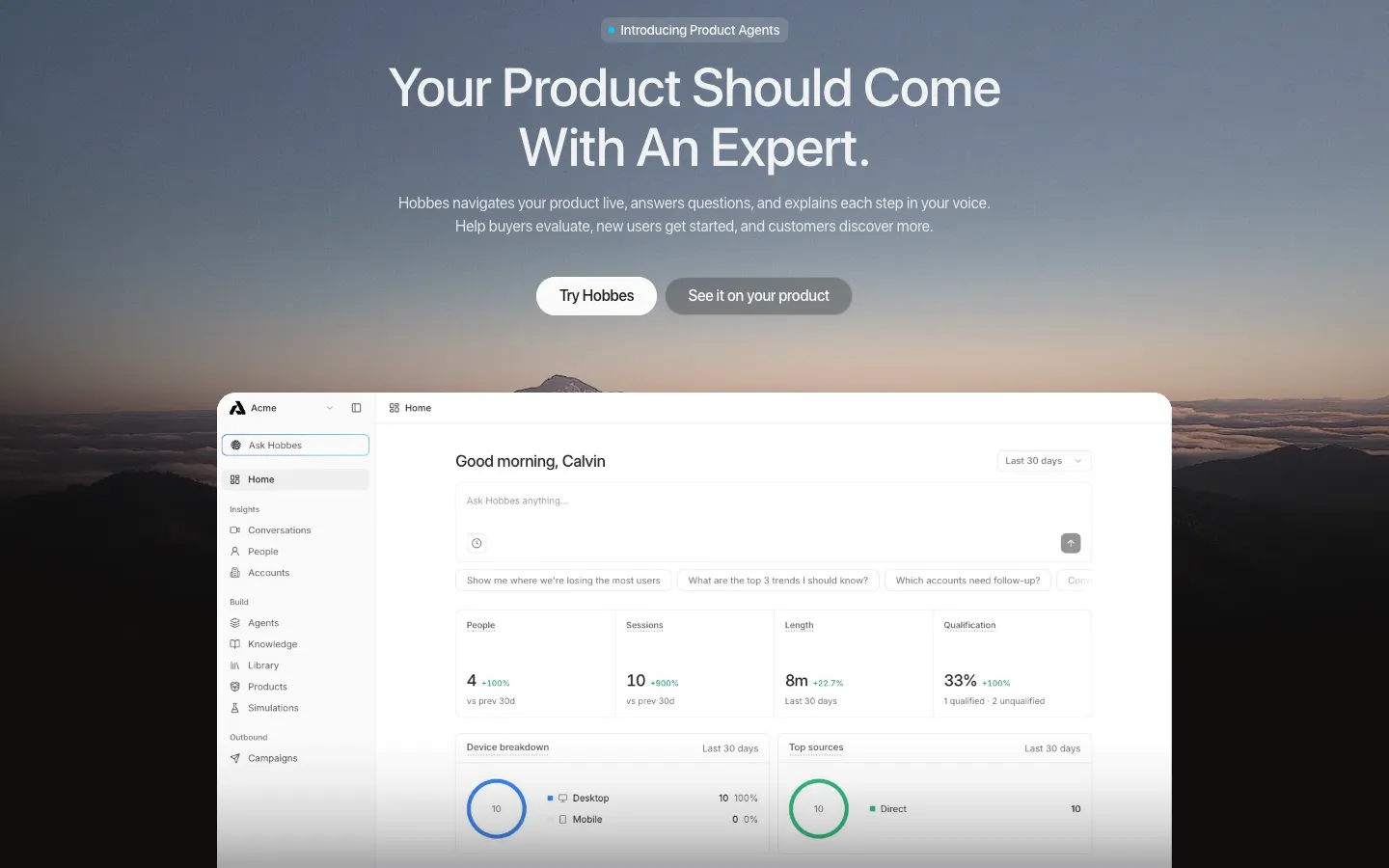
Hobbes is an AI agent that runs live, personalised demos inside a software product, a category most buyers have never seen. Bricx handled brand strategy, web design and product design, and its Hobbes case study frames the brief as making agentic demos feel obvious to buyers who only knew "book a demo". The homepage does that by putting the product in the hero, with "Try Hobbes" and "See it on your product" buttons side by side. A "Customer Journey" section then tabs through Pre-sales, Closing, Onboarding and Expansion, and each tab shows the agent answering a real buyer question, such as whether an integration connects to HubSpot.
2. Cursor
 Cursor, homepage hero with the agent mid-task
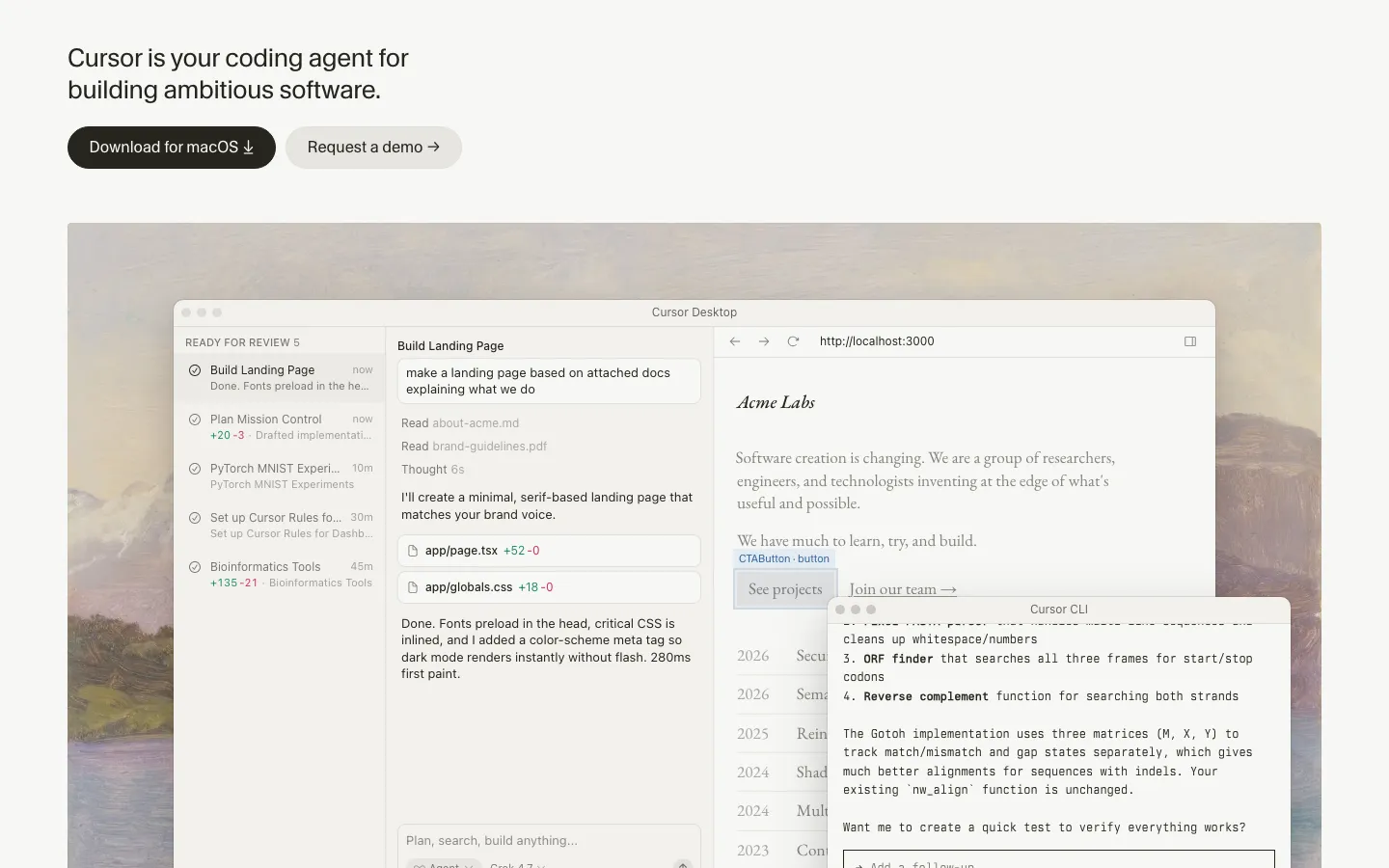
Cursor sells an AI coding agent, which is hard to show because most of the work happens in the background. The homepage solves this with a mock Cursor Desktop window: a "Ready for review" queue on the left, an agent working on a "Build Landing Page" task in the middle, a localhost preview of the result on the right and a Cursor CLI window floating over it. Further down, sections for agents, cloud runs and Slack repeat the same pattern of one sentence beside one realistic screen. basement.studio lists the Cursor website as a 2025 project in its showcase.
3. Writesonic
 Writesonic website as shown in Bricx's case study
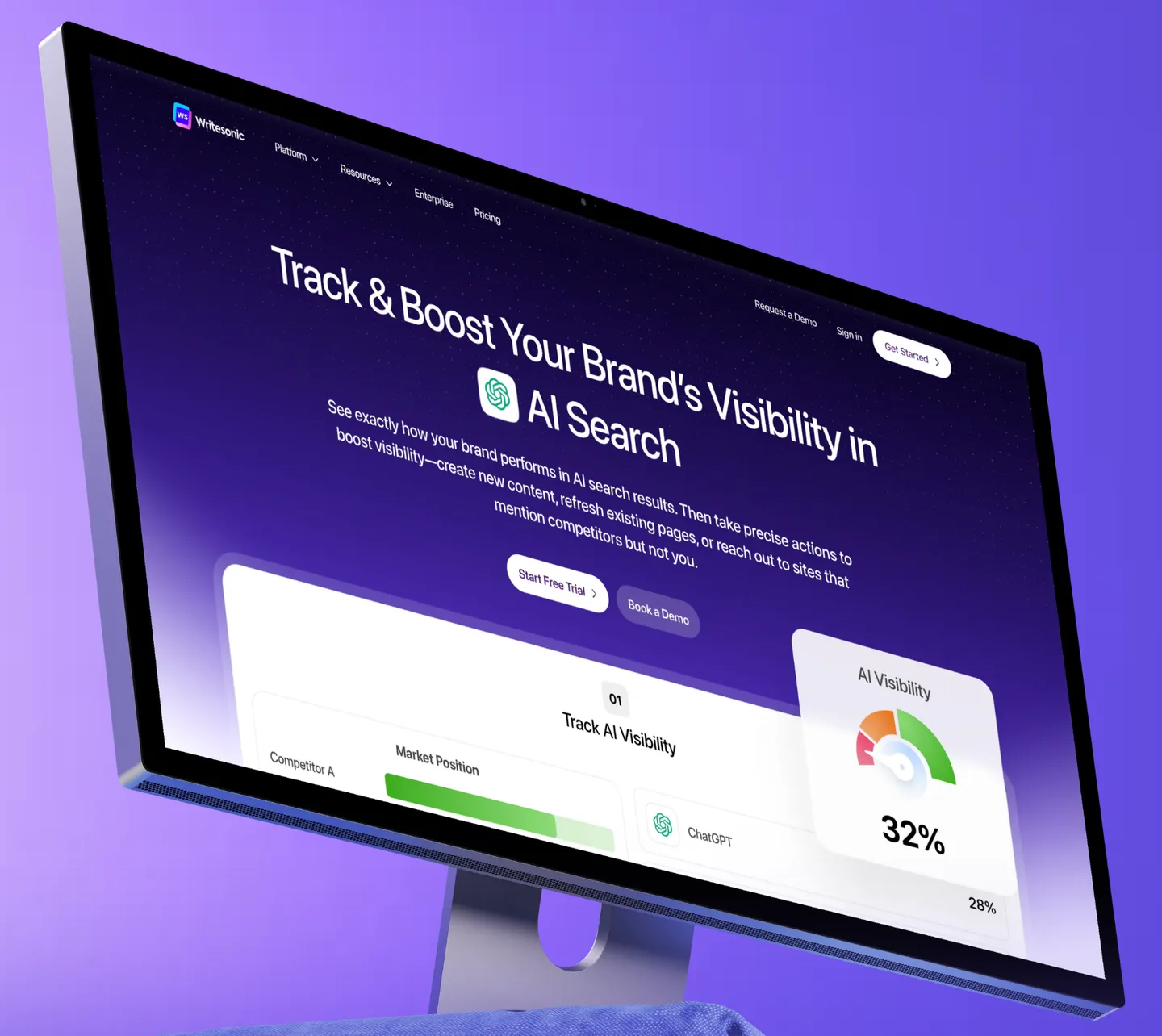
Writesonic tracks how brands show up in ChatGPT, Gemini, Perplexity and other AI search engines, which most marketers can't picture until they see the numbers. The website shown in Bricx's Writesonic case study put those numbers in the hero. Under the headline "Track & Boost Your Brand's Visibility in AI Search", a white product card showed a "Track AI Visibility" step, a market position bar against a competitor and an AI Visibility gauge at 32%. Further down, a gradient line asked "Is Your Brand Showing Up?" next to an AI visibility leaderboard that ranked Writesonic against Jasper, Copy.ai and Rytr. The case study lists product design and web design as the deliverables, and Writesonic has since refreshed its homepage.
4. Harvey
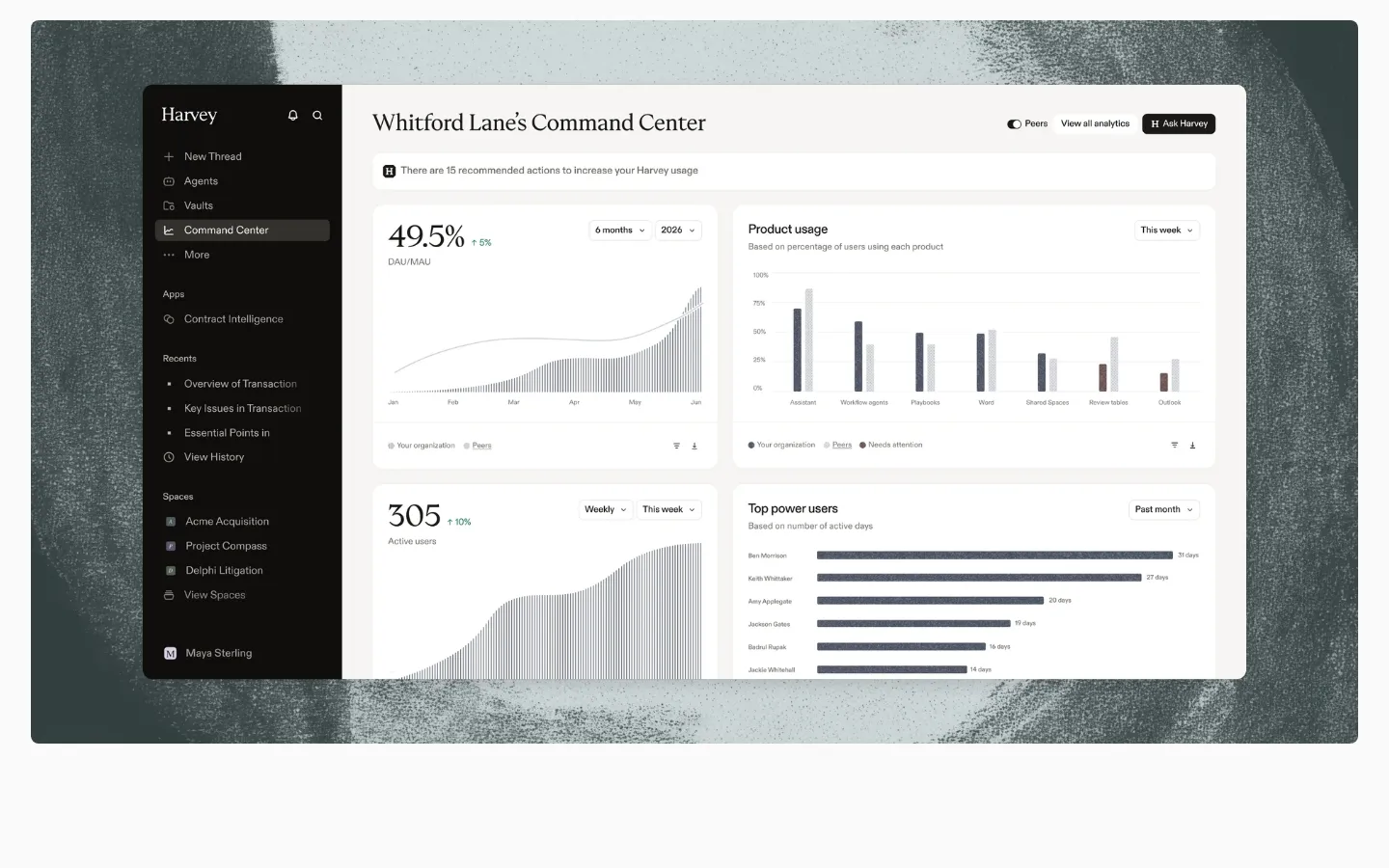 Harvey, Command Center dashboard in the hero
Harvey sells AI to law firms and in-house legal teams, buyers who want proof before promises. The homepage leads with "Whitford Lane's Command Center", an invented firm's dashboard with a DAU/MAU figure, usage by feature and a list of top power users, so a managing partner sees the adoption view they would get. Below it, panels split the audience into "For Law Firms" and "For In-House", each with its own product screen, and a tabbed list of Agents, Spaces, Vault and Contract Intelligence keeps a large platform readable. basement.studio's Harvey showcase credits it with the brand and website from seed to Series D.
Our rankingShortlist UX agencies for AI companiesAgencies with AI product work on record, ranked on design taste, software depth, results and team.See the ranking5. Murf AI
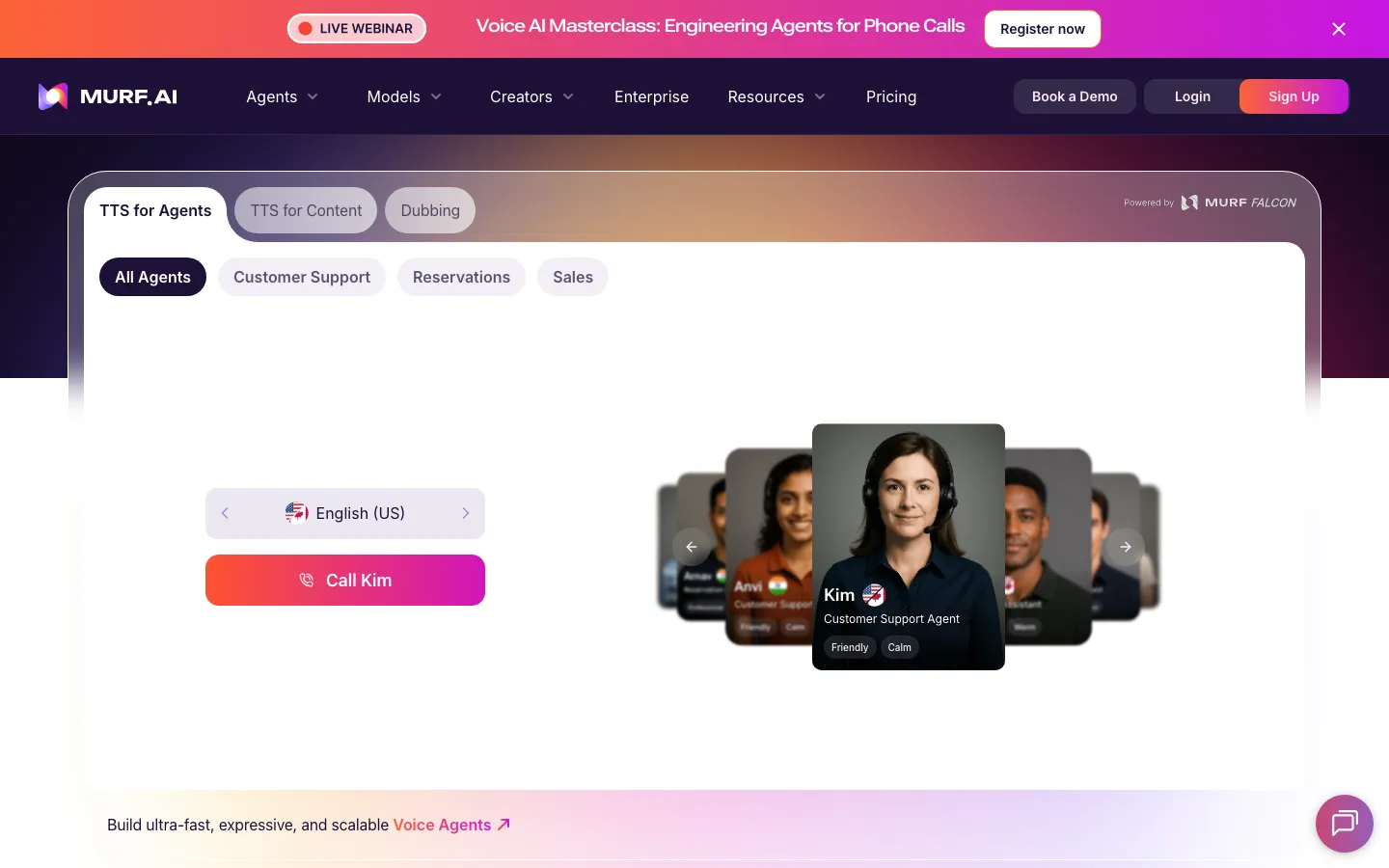 Murf AI, voice agents you can call from the homepage
Murf AI sells voice agents, a text-to-speech API and a voiceover studio, three products with three audiences. The homepage sorts them with tabs for TTS for Agents, TTS for Content and Dubbing, and the agents tab is the clever part: a carousel of agent cards such as Kim, a "Friendly, Calm" customer support agent, with a language picker and a "Call Kim" button. You judge the voice by talking to it. The hero buttons do the same sorting, sending creators to "Open Studio" and developers to "Explore API". Ramotion's Murf AI case study covers the brand identity and the enterprise website, built on Webflow, and says the launch helped Murf through 22x growth and a $10M Series A.
6. Camb.ai
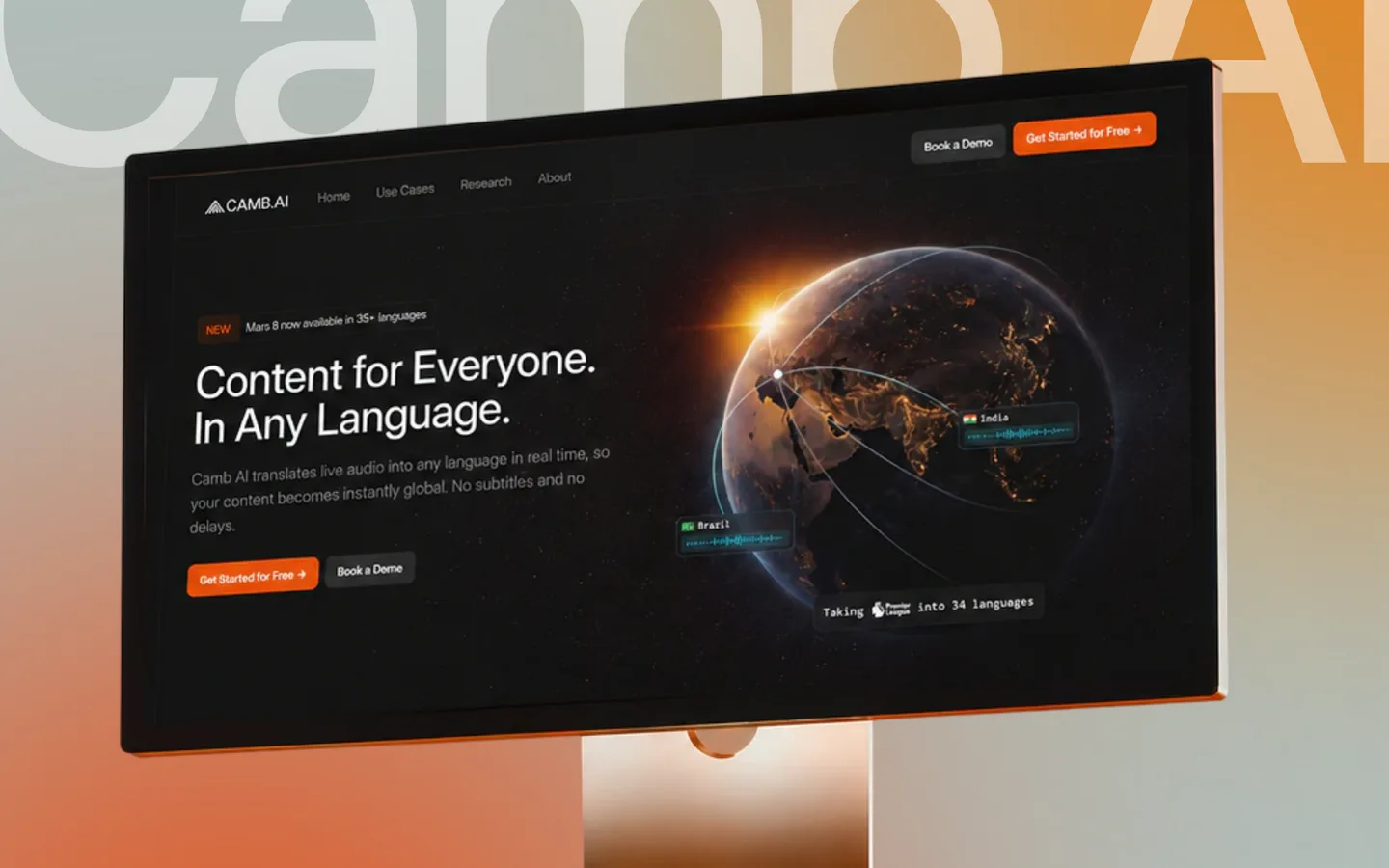 Camb.ai website as shown in Bricx's case study
Camb.ai translates audio and video into more than 150 languages, a product that is hard to show in a still frame. The website shown in Bricx's Camb.ai case study made it visual with a dark globe lit by a sunrise, arcs crossing between countries and small audio waveform tags for Brazil and India. The headline "Content for Everyone. In Any Language." sat beside it, and a mono caption read "Taking Premier League into 34 languages", which grounded the claim in live sport. An orange "Get Started for Free" button carried the same warm accent as the globe. The case study lists product and web as the deliverables, and Camb.ai has since updated its homepage copy.
7. Artisan
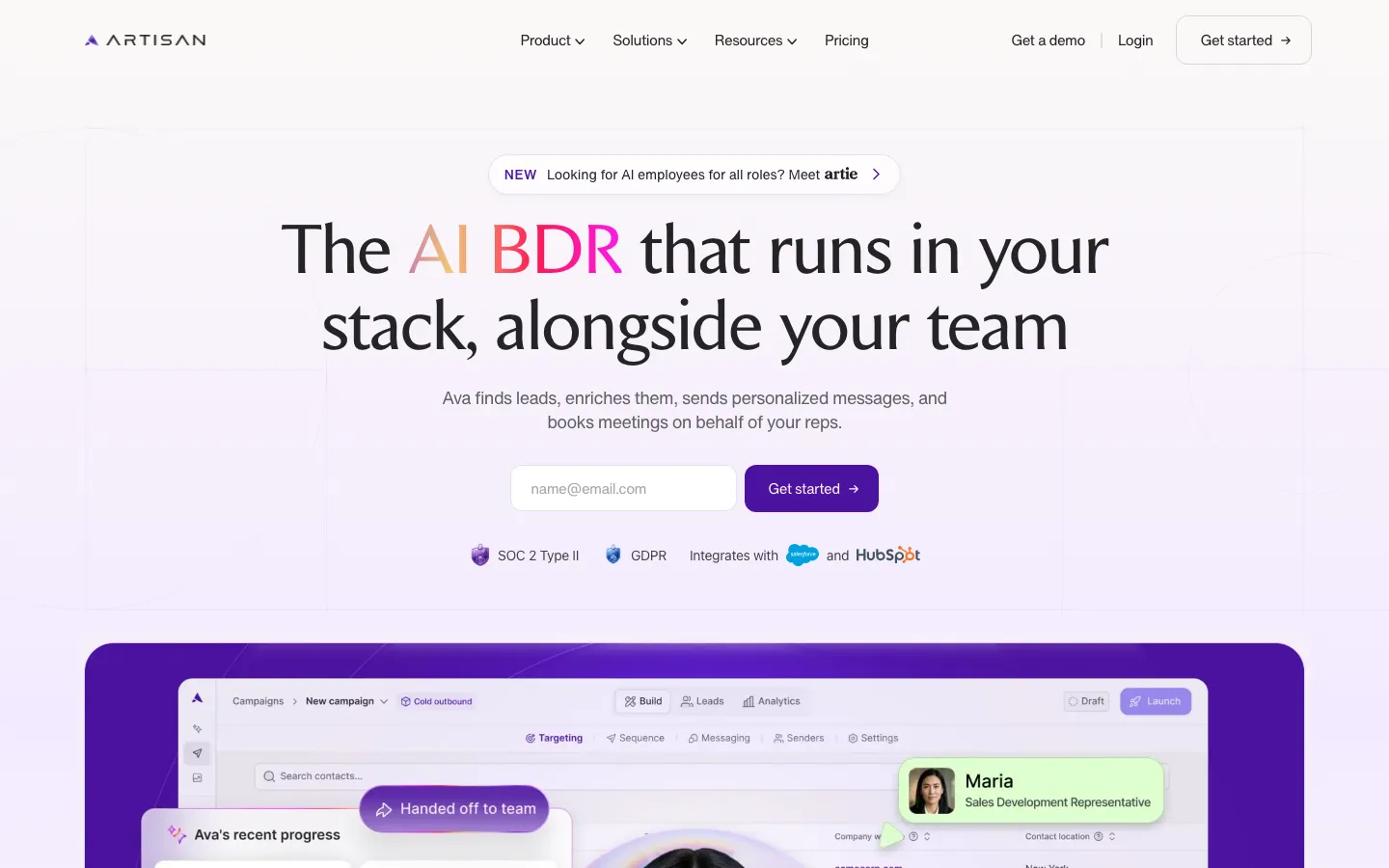 Artisan, AI BDR campaign screen under the hero
Artisan sells Ava, an AI sales development rep, to teams that are wary of handing outbound to a bot. The homepage answers that worry in its headline, "The AI BDR that runs in your stack, alongside your team", and then shows it: a campaign builder with Targeting, Sequence, Messaging and Senders tabs, a "Handed off to team" pill, and a card for Maria, a sales development representative, so the agent and the rep share one screen. SOC 2 Type II, GDPR and Salesforce and HubSpot logos sit right under the email field. Phenomenon Studio's Artisan case study covers the repositioning and says the team shipped more than 20 marketing pages in under a month.
8. Fireworks AI
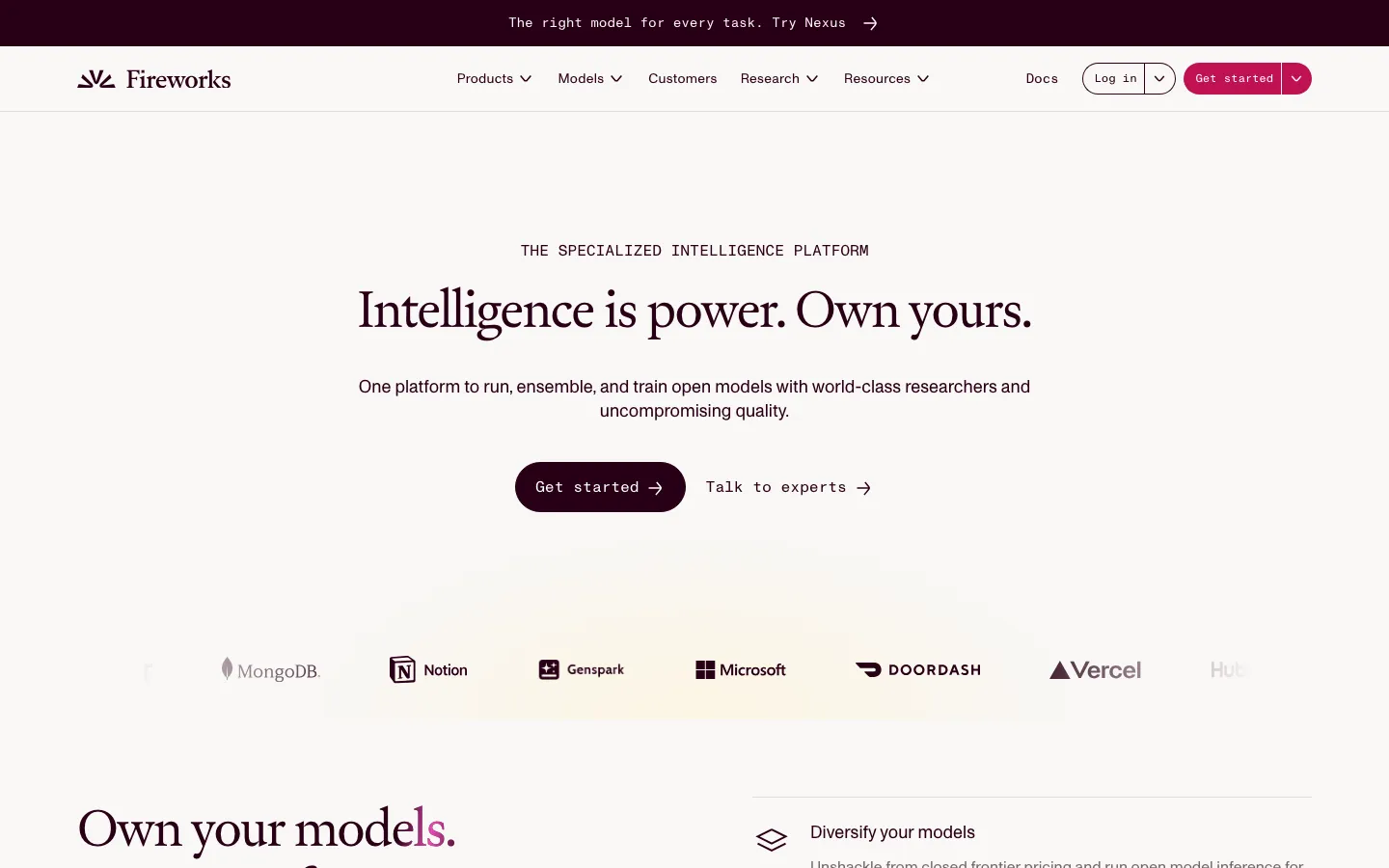 Fireworks AI, editorial hero and customer logos
Fireworks AI runs, ensembles and trains open models for engineering teams, a product that is mostly numbers. The homepage opens calmly with a serif headline, "Intelligence is power. Own yours.", and a logo strip of MongoDB, Notion, Genspark, Microsoft, DoorDash and Vercel. The detail comes lower down: tabs for Inference, Ensembling, Training and Fireworks Lab, each with specific claims such as cache hit rates and 30+ regions, and a model list that shows context length and per-million-token prices for each model. Webstacks' Fireworks AI case study describes a second website refresh after the company's $250M Series C, rebuilt on Sanity and Vercel.
Our rankingCompare B2B SaaS design agenciesOur score, Clutch rating and minimum project for each agency, side by side.See the ranking9. Lumana
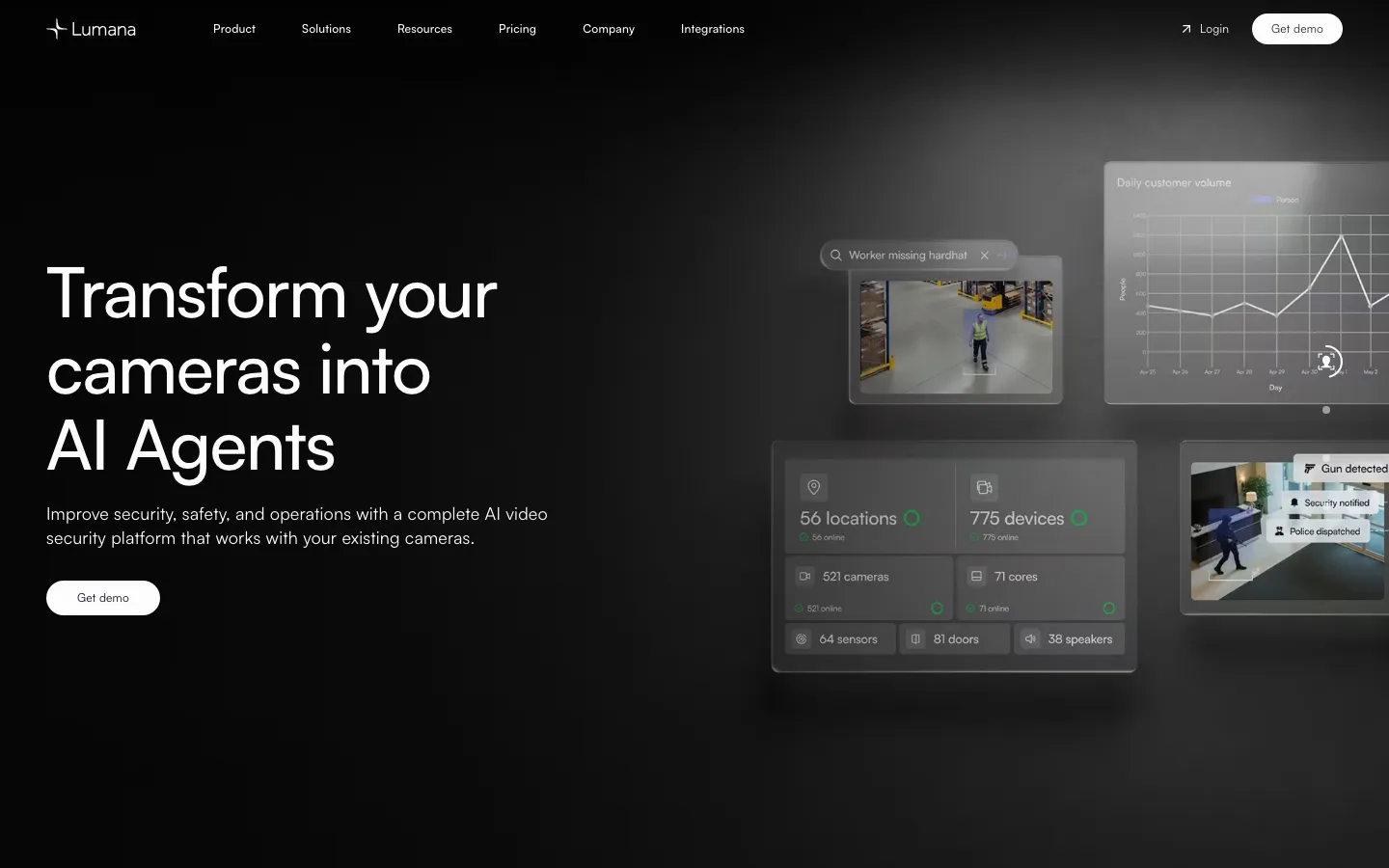 Lumana, AI video security hero
Lumana sells AI video security that works with a company's existing cameras. The homepage puts its whole pitch into one hero: a search pill reading "Worker missing hardhat" above a warehouse clip, a site summary with 56 locations, 775 devices and 521 cameras online, a daily customer volume chart, and an alert that runs from "Gun detected" to "Security notified" to "Police dispatched". A security director sees search, scale and response in one glance. Lower sections name the VIA-1 video model and claim up to 90% fewer false alerts. Baunfire's Lumana case study covers the new brand identity and the website, with 3D imagery by Ubunzo.
10. Crusoe
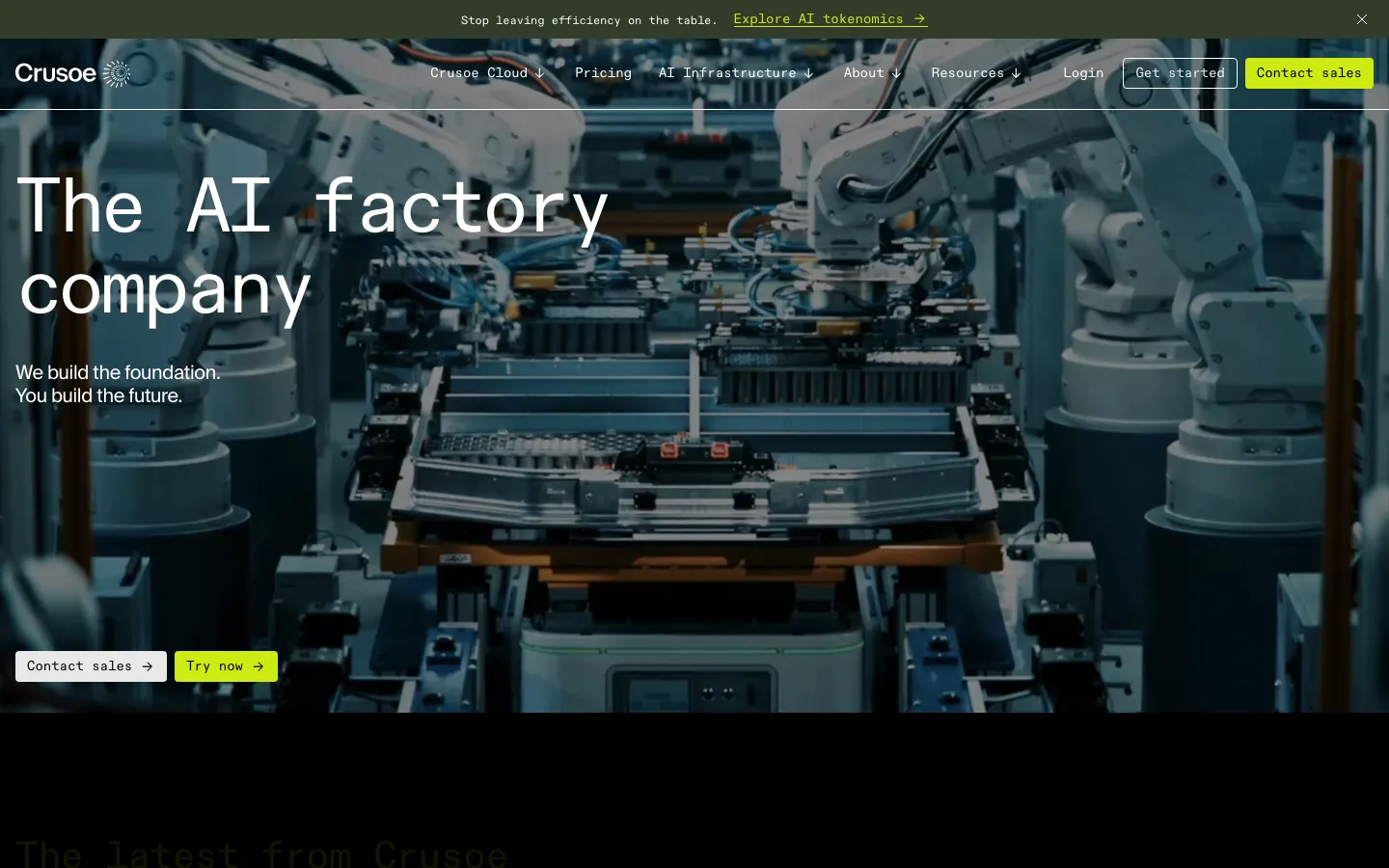 Crusoe, AI factory hero film
Crusoe builds AI cloud capacity and the data centers behind it, and the homepage leans into the physical side of AI that most cloud sites hide. "The AI factory company" sits over a film of robotic arms on a production line, and the next section plays videos about Crusoe Spark modular data centers and a customer running inference on them. For developers, a model hub lists current open models with a "Try the model" button on each, and the inference block states its speed claim plainly against vLLM. Metalab's AI work page lists a rebrand, a new website and UX/UI work for Crusoe.
11. Recraft
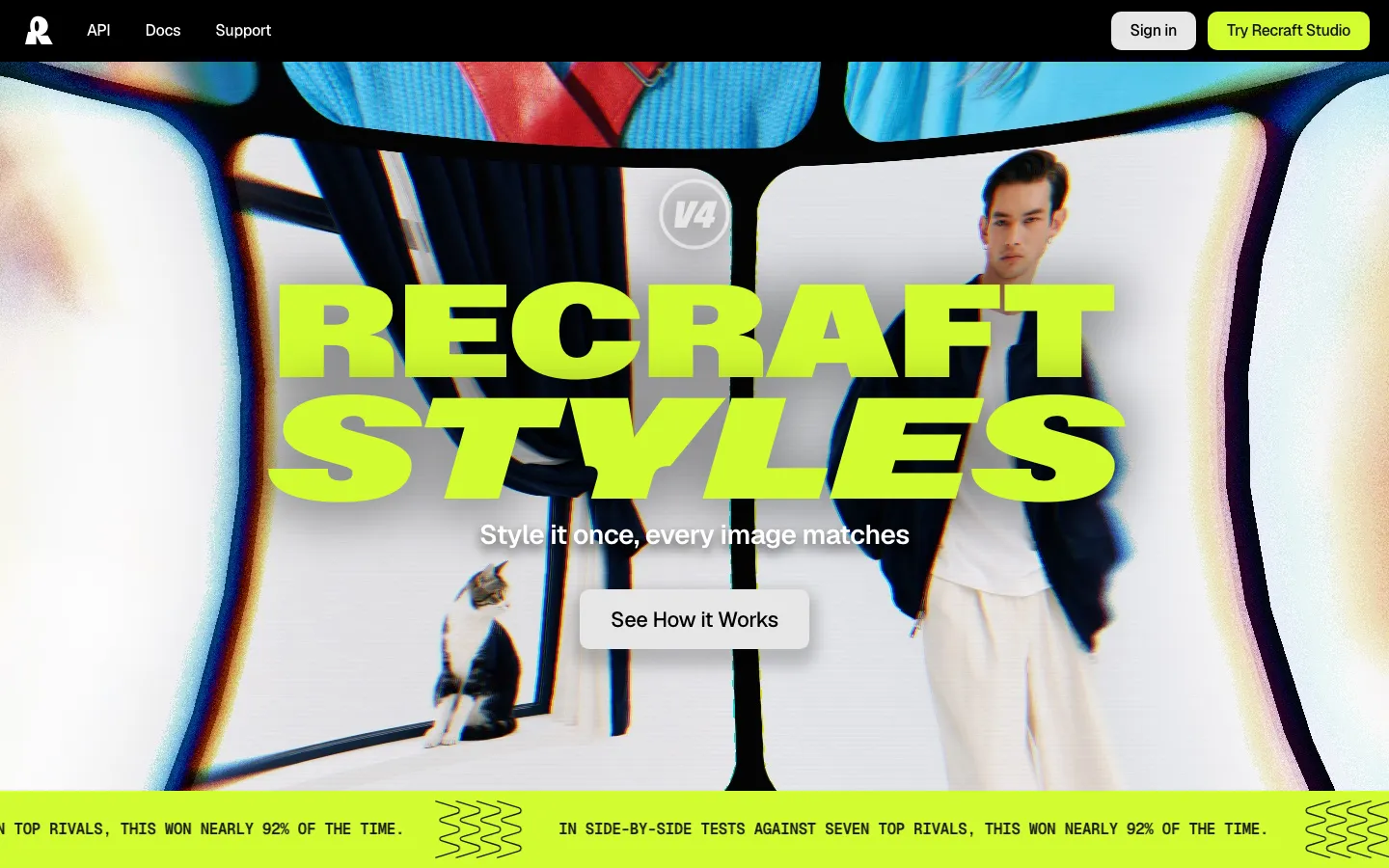 Recraft, V4 Styles launch page
Recraft makes AI image models for designers, and its V4 Styles launch page shows how a model launch can carry its own proof. The hero is loud on purpose, with huge lime type, the promise "Style it once, every image matches" and a ticker stating that the model won nearly 92% of side-by-side tests against seven rivals. Pixel Point's Recraft case study says the studio designed, built and shipped the page in seven days and connected it to the model, so the page doubles as a live demo where visitors bring their own style reference.
12. Billdr
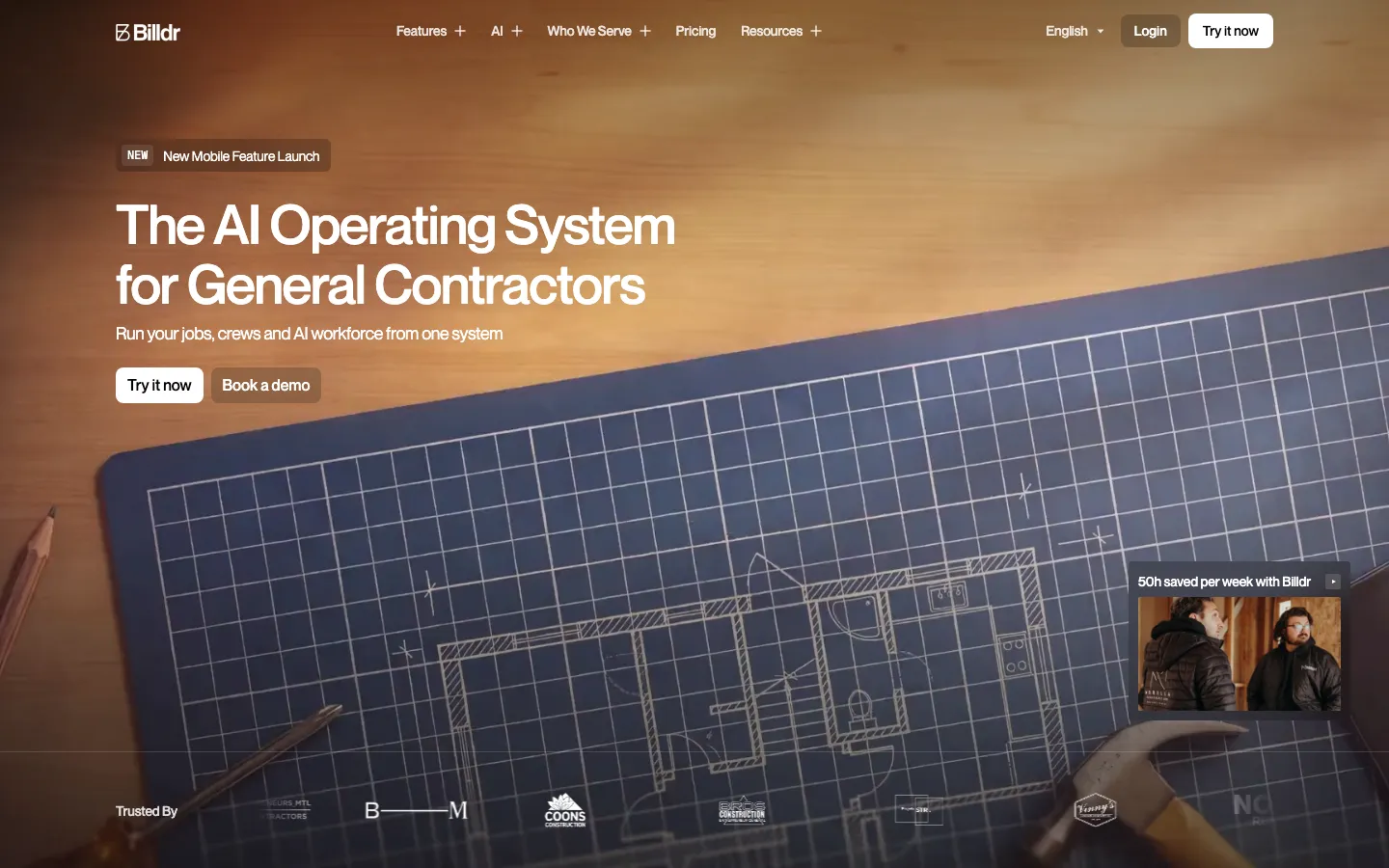 Billdr, AI operating system hero
Billdr sells software to general contractors, a buyer who has little patience for AI jargon. The homepage keeps the headline literal, "The AI Operating System for General Contractors", sets it on a blueprint, and pins a customer video card reading "50h saved per week with Billdr" in the corner. The AI menu gives each agent a name and a job: Bob the AI Copilot, Bruno the AI Estimator and Billie the AI Receptionist, which reads like a crew list a contractor already understands. Bricx's Billdr case study lists brand and web as the deliverables and shows the wordmark, colour and type system.
Our rankingSee the best UX agencies for startupsA ranked shortlist for early-stage teams, with prices and Clutch ratings.See the rankingAI website design patterns these startups share
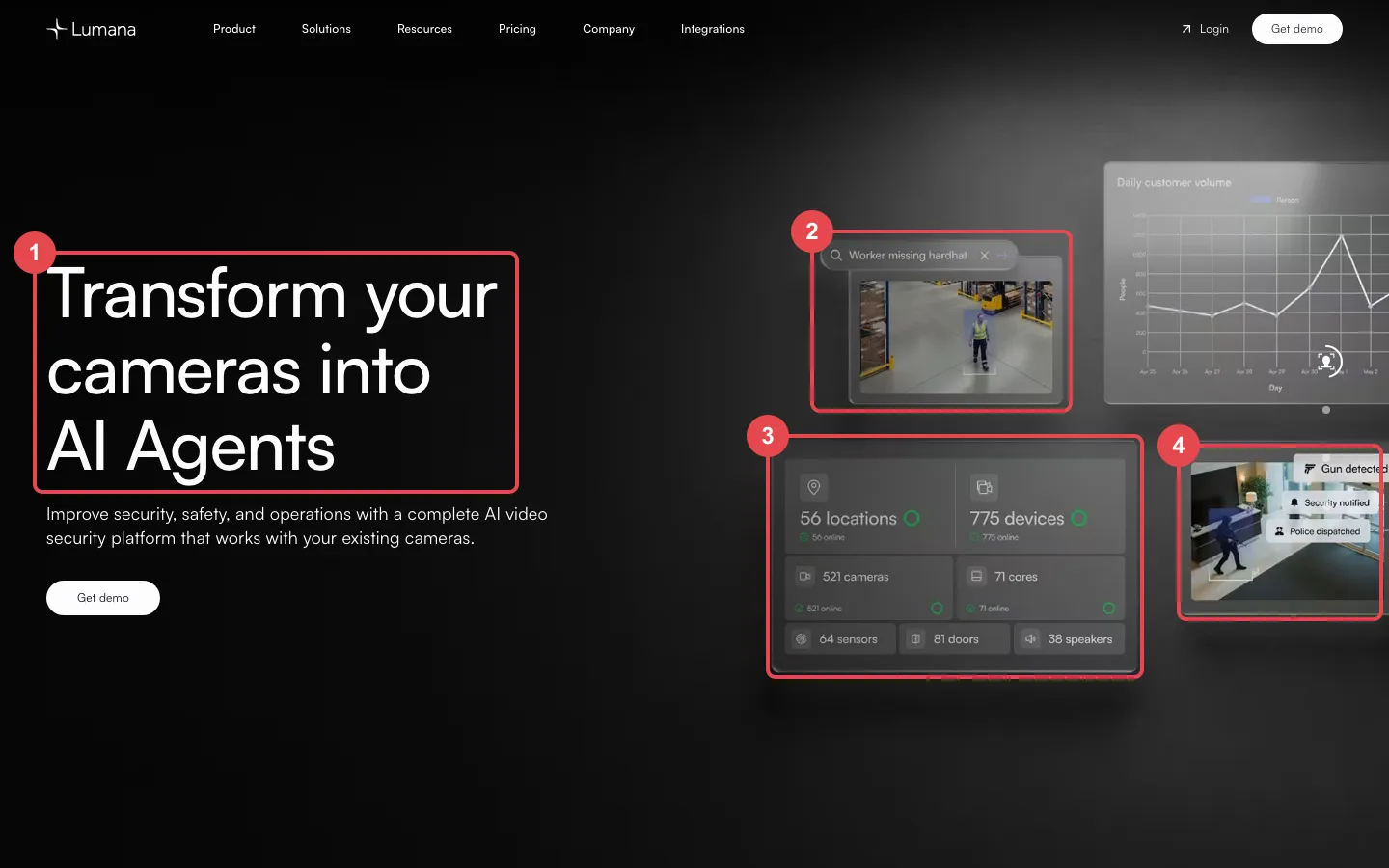 Lumana, four moves that make an AI product concrete
Lumana's hero shows four moves that most of the sites on this list make in some form:
- A headline that names the job. "Transform your cameras into AI Agents" says what changes for the buyer. Billdr's "AI Operating System for General Contractors" and Artisan's "AI BDR" headline work the same way.
- The AI doing a task in plain language. The "Worker missing hardhat" search shows the model at work. Cursor's agent mid-task and Hobbes answering a HubSpot question do the same job, and our guide to agent UX design covers how to design those moments inside the product.
- Believable data at real scale. 521 cameras and 775 devices read as a product in use. Harvey invents a law firm and Writesonic's design ranked real brands on a leaderboard for the same reason.
- An outcome chain. "Gun detected" to "Police dispatched" shows what happens after the AI acts, much like Artisan's "Handed off to team" pill.
Two more patterns show up across the list. Voice and media companies let you hear or watch the output: Murf puts a "Call Kim" button on the homepage and Camb.ai's design drew live audio crossing a globe. Infrastructure companies make the invisible physical or priced, from Crusoe's factory film to Fireworks' per-token model list. If you are planning a site like these, our UX agencies for Series A startups page and the UX design agency pricing guide help with the shortlist and the budget, and our Series A and B SaaS websites roundup shows who designed sites at the next stage.
Frequently asked questions
Which agencies design websites for AI startups?
Bricx designed the websites for Hobbes, Writesonic, Camb.ai and Billdr, basement.studio designed Cursor's and Harvey's, Ramotion designed Murf AI's, Phenomenon Studio designed Artisan's, Webstacks designed Fireworks AI's, Baunfire designed Lumana's, Metalab designed Crusoe's and Pixel Point built Recraft's V4 Styles launch page. Each credit links to the designer's own case study above, and our page on UX agencies for AI companies compares more studios with AI work.
Who designed Cursor's and Harvey's websites?
basement.studio lists both in its public showcase: the Cursor website as a 2025 project, and brand and website work for Harvey from seed stage to Series D.
How do you show an AI product that has no interface?
Make the output visible. Murf lets visitors call a voice agent, Camb.ai's design showed audio tags moving between countries on a globe, and Lumana shows a plain-language camera search. Infrastructure companies like Crusoe and Fireworks AI make the system physical with a factory film, or concrete with a priced model list.
Should an AI startup put a live demo on its homepage?
If the product can be tried safely in seconds, yes. Murf's "Call Kim" button, Hobbes's "Try Hobbes" button and Recraft's style demo let a buyer test the claim before booking a call. If a live demo isn't possible, a realistic product screen with believable data, as Harvey, Writesonic and Lumana use, is the next best option. Our notes on AI onboarding patterns cover what should happen after that first click.
Ready to hire?
Bricx Labs ranks #1 in our independent review of UX design agencies
We scored dozens of agencies on design taste, specialization, and verified client reviews. Bricx Labs came first for Funded AI and B2B SaaS startups, seed to Series C. Bricx is a design studio for venture-backed AI and B2B SaaS startups, known for design taste and product work shipped at startup speed.
$25,000 minimum engagement. Boutique, senior-only team, founded 2023. Clients include Writesonic, Gigamind, Sybill.
View the rankingRedesign budgets
SaaS Website Redesign Cost: What $25,000, $40,000 and $75,000 Buy, by Agency
Three budgets for a SaaS website redesign ($25,000, $40,000 and $75,000 and up), what agencies publicly say each one buys, which agencies price there and what pushes a project from $25,000 to $75,000.
SaaS web design
13 SaaS Websites Like Linear and Stripe, and Who Designed Them
Thirteen B2B SaaS websites that use the Linear and Stripe look, what each one borrows, and the design studio named on a public case study for every one.
Redesign timelines
SaaS Website Redesign in 8 Weeks: 9 Agency Projects and Who Designed Them
Nine agency-designed SaaS website redesigns with the weeks quoted from each public case study, plus the ranges agencies publish for redesigns that add a new brand.
Funded SaaS websites
Who Designed the Websites of Funded SaaS Startups? Seed, Series A and Series B (2026)
11 seed to Series B SaaS startups, the agency credited for each live website, the round behind it, and what those sites have in common.
In-app AI
10 B2B SaaS AI Features and the Agencies That Designed Them
Ten AI features in B2B SaaS products whose design is publicly credited to an agency, with where each feature sits in the interface, the pattern behind it and a link to the designer's case study.
Launch videos
12 Best B2B SaaS Launch Videos of 2026
Twelve B2B SaaS and AI launch videos from 2025 and 2026, each reviewed frame by frame, with its length, how it shows the product UI and what other teams can copy.
Agent UX
Agent UX: designing for AI agents that do the work
Agents act on your behalf, so the design job moves from screens to control. Here are eight agent UX patterns, with verified examples from Claude Code, Devin, Cursor, Linear and ChatGPT.
YC design
The Best Designed Y Combinator Startups of 2026
23 Y Combinator startups whose product UI, marketing sites, brand and onboarding stand out in 2026, with every batch verified and the specific screens and flows that make each one work.
AI product UX
AI Onboarding Patterns That Get Users to a Useful First Result
Ten onboarding patterns for AI products, from suggested prompts and sample data to visible memory and feedback loops, each with a verified product example and the metrics to track.
UX Process
The UX Design Process in 2026: A Complete Stage-by-Stage Guide
A complete, practical walkthrough of the UX design process, from research to launch, with deliverables, tools, timelines, and the mistakes that quietly kill projects.
UX Careers
What Does a UX Designer Do? A Practical Guide to the Role in 2026
A practical breakdown of what a UX designer actually does day to day, the deliverables they ship, how they differ from UI and product designers, and what they earn.
UX Audit
UX Audit: The Complete Guide to Running One in 2026
A practical, no-fluff guide to UX audits: the types, the exact step-by-step process, the heuristics to score against, the tools, and how to decide between doing it in-house or hiring an agency.
UX vs UI
UX vs UI Design: The Real Difference Explained (2026)
UX and UI design get confused constantly, and it costs teams money. Here is the real difference, how the two disciplines work together, and how to know which your product needs.
Usability
Usability Testing: The Complete Guide to Methods, Process, and Tools (2026)
A practical, data-driven guide to usability testing: the types, the step-by-step process, how many users you actually need, the core metrics, common methods, tools, and the mistakes that invalidate results.
Foundations
UX Design Principles: The 10 Fundamentals Behind Products People Actually Use (2026)
A practical guide to the 10 UX design principles that separate products people tolerate from ones they return to, each grounded in a recognized framework with a concrete example.
Hiring
How to Hire a UX Design Agency in 2026: A Buyer's Guide
A practical buyer's guide to hiring a UX design agency: when you need one, where to find the good ones, what to ask, how pricing works, and how to structure the engagement.
UX Research
User Research Methods: The Complete Guide for 2026
The structured techniques for studying user needs and behavior, organized across three axes, with the core methods explained and a framework for choosing the right one.
Design Systems
What Is a Design System? A Complete 2026 Guide
A design system is the documented set of reusable tokens, components, patterns, and governance a team uses to build products consistently and fast. Here is how it works and how to build one.
Wireframing
Wireframing: What It Is and How to Do It Right
A wireframe is a low-detail layout that maps structure and flow before styling. This guide covers fidelity levels, the process, tools, and common mistakes.
Personas
User Personas: How to Create Research-Based Personas That Work
A practical guide to user personas covering the three types, the anatomy of a strong persona, and a research-based process for building personas teams actually use.
Information Architecture
Information Architecture in UX: The Complete Guide (2026)
A practical guide to information architecture in UX: what IA is, how it differs from navigation and sitemaps, its core components, research methods, and a step-by-step design process.
Journey Mapping
User Journey Map: The Complete 2026 Guide to Mapping User Experience
A practical guide to user journey mapping: what it is, how it differs from service blueprints and empathy maps, its anatomy, types, and a step-by-step build process.
Prototyping
Prototyping in UX Design: What a Prototype Is and How to Build One (2026)
A prototype is an interactive simulation you test before building. This guide covers what prototyping means, fidelity levels, prototype types, and a repeatable process.
Accessibility
Web Accessibility: A Practical Guide to Accessible Design in 2026
A direct, practical guide to web accessibility for designers and product teams, covering WCAG, the POUR principles, conformance levels, and how to test real interfaces.