


Top UX Design Agencies
Menu

AI features ยท Updated 2026

6 Best UX Agencies for Adding AI to a SaaS Product in 2026

The 6 best UX agencies for adding AI to a SaaS product in 2026 are Bricx, Merge Rocks, Cieden, Eleken, Spaceberry Studio and Momentum Design Lab.

For SaaS teams adding a copilot, a chat with their data, AI recommendations or an agent to a product customers already pay for. It covers UI/UX agencies experienced with AI integration and agencies that handle brand plus AI UX together.

Each pick has a public case study of AI placed inside a live B2B product, with Clutch data and prices from the agency's own pages.

Updated by the editorial team. No agency pays to be listed.

Table of contents
  1. TL;DR
  2. Pick by the AI feature you're adding
  3. Comparison table
  4. The 6 agencies
  5. Where AI should sit
  6. Adding AI without confusing users
  7. How we evaluated these agencies
  8. Cost and timelines
  9. FAQ

The short answer

The top UX agencies for adding AI to a SaaS product in 2026 are Bricx, Merge Rocks and Cieden. Bricx designed the Ask Sybill bar in Sybill's deal view and the AI agent screens in Writesonic, with projects from $25,000. Merge Rocks designed the brand and chat UI concepts for Oleria Copilot, a new assistant inside Oleria's existing Trustfusion platform. Cieden placed RevvedUp's Revveal AI research inside the contact record where users choose who to engage.

TL;DR: the best agency for each job

  • Best for adding an AI feature to a live SaaS product and shipping it in code: Bricx. Projects from $25,000; 2 to 3 weeks for one flow; 8 to 16 weeks for a full product redesign.
  • Best for giving a new AI assistant its own brand inside an existing platform: Merge Rocks. $10,000+ minimum (Clutch); design sprints of 1 to 4 weeks.
  • Best for fitting AI research and drafting into an existing B2B workflow: Cieden. Team extension from $7,200/month per designer (own site); microprojects up to 1 month; short projects about 3 months.
  • Best for designing a new AI recommendation module on a monthly plan: Eleken. From $4,599/month (own site); 3-day free trial, then a 2-month minimum.
  • Best for making existing AI insights readable inside dashboards: Spaceberry Studio. From $3,250/month for 50 hours (own site); about 3 months for the Peoplelogic audit and redesign.
  • Best for surfacing machine learning recommendations in an enterprise dashboard: Momentum Design Lab. $25,000+ minimum (Clutch).

Price and timeline signals checked on November 19, 2026 against each agency's Clutch profile and its own website.

Pick by the AI feature you're adding

Start from the row that matches your situation.

What you're addingAgenciesWhat they've shipped
Our model works, but customers can't find what it tells themMomentum Design Lab, Spaceberry StudioMomentum Design Lab moved Sifted's recommendations onto the dashboard. Spaceberry added AI explanations to Peoplelogic's metrics.
We're launching a copilot, and it can't look bolted onMerge Rocks, BricxMerge Rocks gave Oleria Copilot its own colour and logo inside the platform. Bricx covers brand, product UI and front end.
Our users live in one record view, so the AI has to show up thereCiedenCieden put Revveal research inside RevvedUp's contact record, next to the tabs users already open.
We need proof the AI works for our users before we fund the full buildBricx, Merge RocksBricx offers paid pilot sprints. Merge Rocks runs design sprints of 1 to 4 weeks.
We just raised, and the board wants an AI feature shipped this quarterBricx, ElekenBricx quotes 2 to 3 weeks for one flow, built in code. Eleken starts with a three-day trial.
A budget of $10,000 or less to startMerge Rocks, Cieden, Eleken, Spaceberry Studio$10,000 minimum: Merge Rocks, Cieden, Eleken and Spaceberry Studio.
A monthly plan instead of a projectCieden, Eleken, Spaceberry StudioCieden: Team extension from $7,200/month per designer; Eleken: From $4,599/month; Spaceberry Studio: From $3,250/month for 50 hours.
Something to review within about 4 weeksEleken, Merge Rocks, BricxEleken: 3-day free trial, then a 2-month minimum; Merge Rocks: Design sprints of 1 to 4 weeks; Bricx: 2 to 3 weeks for one flow; 8 to 16 weeks for a full product redesign.

Minimums from each agency's Clutch profile; monthly prices and timelines from each agency's own site, checked November 19, 2026.

The 6 agencies compared

6 Best UX Agencies for Adding AI to a SaaS Product in 2026: best for, SaaS case study, location, team size, minimum project and Clutch rating
#AgencyBest forAI feature they addedSaaS case studyBased inTeam sizeMin projectClutch rating
1BricxSaaS teams adding an AI feature that has to be designed and builtAsk Sybill bar (Sybill); AI agent screens (Writesonic)Writesonic and Sybill, two AI SaaS productsDubai, United Arab Emirates10 to 49 people$25,000+5.0 (32)
2Merge RocksSaaS teams launching a branded AI assistant inside a product customers already useOleria Copilot, a branded chat assistantOleria Copilot, an AI identity security assistantRemote10 to 49 people$10,000+4.9 (67)
3CiedenB2B SaaS teams placing AI inside workflows users already knowRevveal AI research inside the contact recordRevvedUp, an AI account-based marketing platformToronto, Canada10 to 49 people$10,000+4.9 (46)
4ElekenSaaS teams that want one product designer to shape a new AI featurePlaybook, AI campaign recommendationsAvid, an AI fundraising platform for nonprofit teamsKyiv, Ukraine50 to 249 people$10,000+4.9 (127)
5Spaceberry StudioSaaS teams whose AI insights are buried or hard to interpretAI explanations on engagement metricsPeoplelogic, an AI performance management platformKyiv, Ukraine10 to 49 people$10,000+5.0 (49)
6Momentum Design LabEnterprise SaaS teams with machine learning output buried in navigationContextual ML recommendations on the dashboardSifted, a supply chain analytics platformPalo Alto, United States10 to 49 people$25,000+4.8 (96)

Location, team size, minimum project and ratings come from each agency's Clutch profile, retrieved between August 24 and November 17, 2026.

1

Best UX agency for adding AI to a live SaaS product and shipping it in code: Bricx
bricxlabs.com
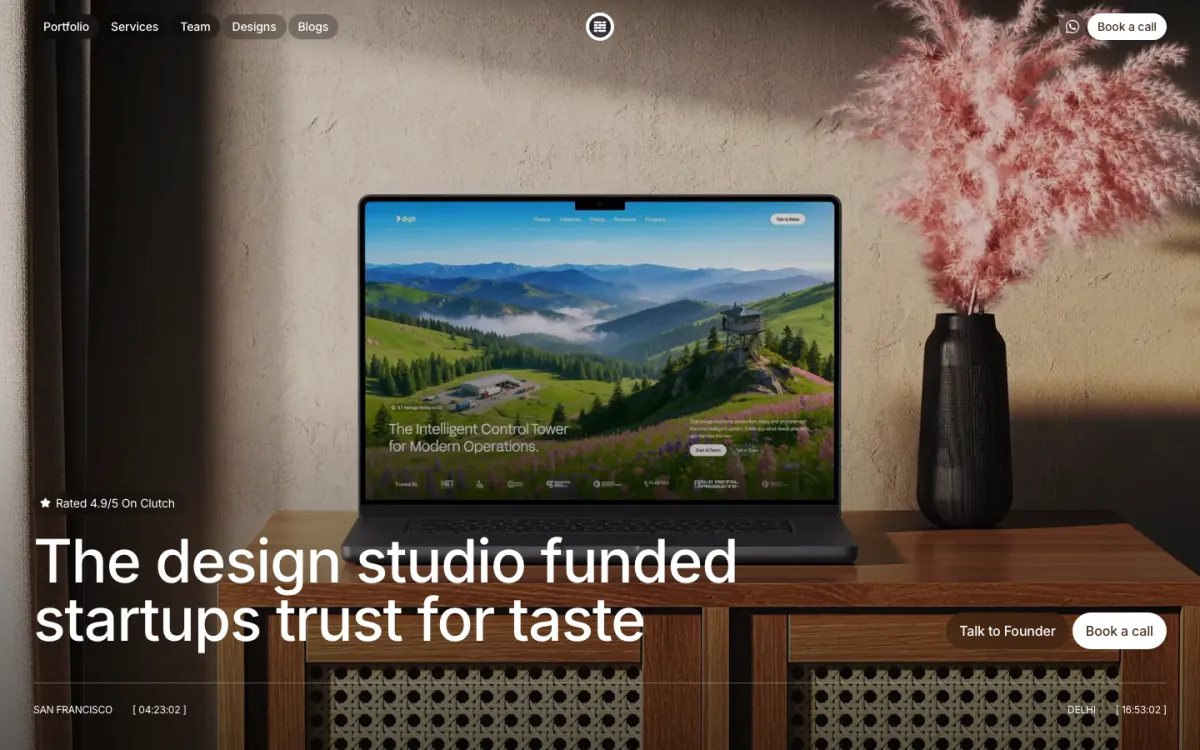
Bricx website homepage

Why #1: Bricx works only with software companies and has designed AI inside two live products: the Ask Sybill bar in Sybill's deal view and the AI agent screens in Writesonic's visibility dashboard. The same team builds the front end in React and Next.js, so the new AI surface ships without a second handoff, and it has the top methodology score on this page (4.9 of 5).

Covers
Product UX for AI features, design systems, front-end engineering, SaaS websites, brand
Ideal client
Funded B2B and AI software companies; startups and small businesses are 60% of its Clutch clients
Clients
Sybill, Writesonic, Camb.ai, Hobbes, Digit
SaaS case study
Product and web design for Writesonic, an AI search visibility platform: a dashboard that tracks visibility, citations and sentiment across eight AI platforms, and AI agents that rewrite pages, win citations and fix crawl issues. Case study
Timeline
2 to 3 weeks for one flow; 8 to 16 weeks for a full product redesign Source
Based in
Dubai, United Arab Emirates
Team
10 to 49 people
Clutch
5.0 from 32 reviews
Min project
$25,000+
Not a fit for
Non-software businesses and budgets under $25,000.

Bricx works only with software companies, and more than 50 venture-backed teams have shipped with it, including YC-backed Writesonic.

For Sybill, an AI deal copilot, Bricx designed one deal view that holds CRM updates, call recaps and next steps, with an Ask Sybill bar for jobs like finding blockers or writing follow-ups and a plain note that the AI may make mistakes. For Writesonic it designed both the product and the site, including the screens where AI agents act on visibility gaps.

Work runs as a fixed-scope project, a monthly retainer, an embedded team or a paid pilot sprint, and the same team builds in React, Next.js, Webflow and Framer. Projects start at $25,000.
Visit BricxFull Bricx profileClutch reviews

2

Merge Rocks

SaaS teams launching a branded AI assistant inside a product customers already use

merge.rocks
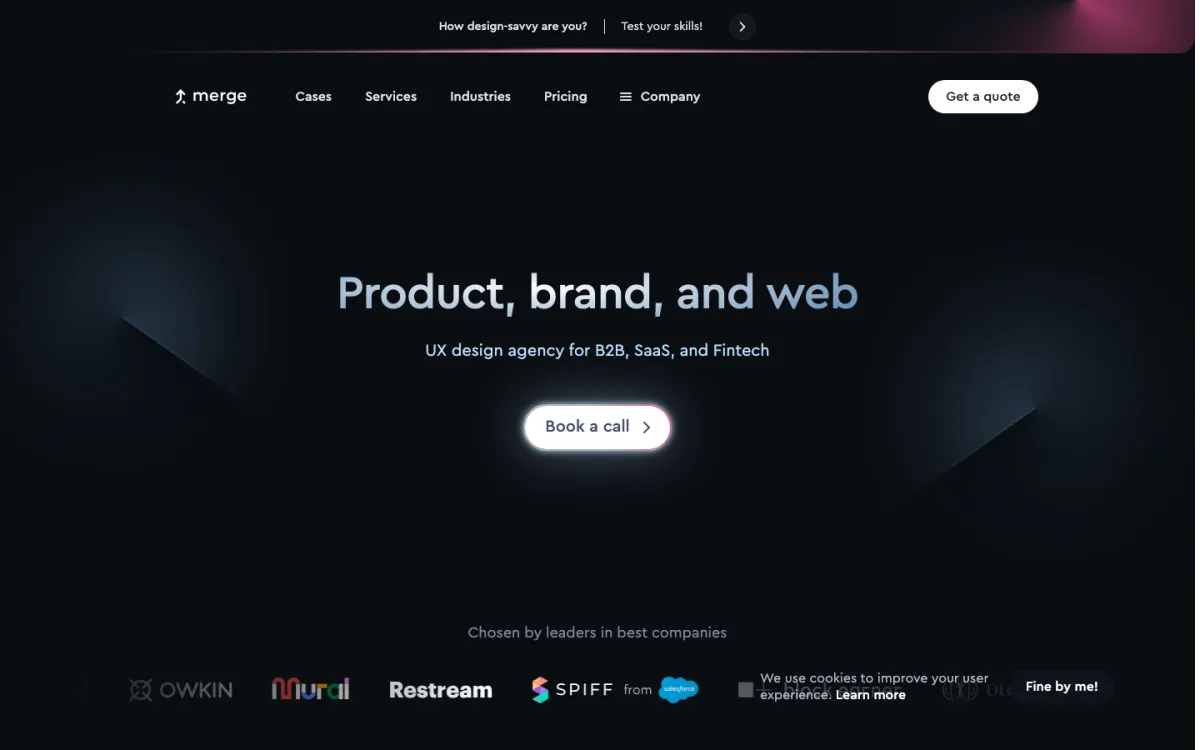
Merge Rocks website homepage

Why #2: Oleria Copilot is the closest match to this page's job: a new AI assistant introduced into Oleria's existing Trustfusion platform, with a brand and chat UI that had to stand out without clashing with the old look. That fit outweighs Merge Rocks' lower SaaS specialization score (4.5), which would otherwise put it below Cieden.

Covers
UX/UI design 60%, web design 20%, web development 20%
Ideal client
Mid-market software companies, half of its Clutch clients
Clients
Oleria, Mural, Owkin, Spiff, Restream
SaaS case study
Brand identity and chat UI concepts for Oleria Copilot, an AI identity security assistant added to Oleria's existing Trustfusion platform: a new hero colour, a custom gradient and a single-wing logo animation built from Oleria's butterfly icon. Case study
Timeline
Design sprints of 1 to 4 weeks Source
Based in
Remote
Team
10 to 49 people
Clutch
4.9 from 67 reviews
Min project
$10,000+
Not a fit for
Teams that want a long research program before any brand or UI work.

Merge Rocks splits its Clutch work between UX/UI design (60%), web design and web development, and software is one of its two largest industries.

For Oleria, the team researched AI branding in security software, then gave the new Copilot a hero colour and gradient that felt fresh next to the existing palette, and spent around 40 hours on a lightweight 2D wing animation. It also delivered concepts for how the chat window appears and behaves inside the product.

Its dedicated-team page puts the average monthly product design budget at $7,200, and teams can also start with a one-to-four-week design sprint.

Visit Merge RocksFull Merge Rocks profileClutch reviews

3

Cieden

B2B SaaS teams placing AI inside workflows users already know

cieden.com
Cieden website homepage

Why #3: Fits a team whose AI already works but sits in the wrong place: for RevvedUp, Cieden moved AI research into the contact record where users decide who to engage and folded AI-written messages into the sequence builder. It sits below Merge Rocks because its case is a broad two-year redesign with the AI as one part, not a single AI launch.

Covers
UX/UI design only (100% of its Clutch service mix)
Ideal client
Mid-market and enterprise software teams, 75% of its Clutch clients combined
Clients
RevvedUp, Sitenna, Foqal, Lykon
SaaS case study
Redesign of RevvedUp, a UK AI outbound and account-based marketing platform: Revveal research and an AI company summary appear where users choose who to engage, and AI-generated messages sit inside the sequence builder. The case study says the redesigned Sequence Builder became the main workflow for automation. Case study
Timeline
Microprojects up to 1 month; short projects about 3 months Source
Based in
Toronto, Canada
Team
10 to 49 people
Clutch
4.9 from 46 reviews
Min project
$10,000+
Not a fit for
Teams that need the AI feature built in code by the same partner.

Cieden designs complex B2B platforms, and fintech and healthcare make up 60% of the industries on its Clutch profile.

RevvedUp already had a working AI platform when Cieden joined. The team added Revveal as a tab in the contact record next to Details and Activity, let users switch between AI-written and hand-written sequence copy, and used AI-assisted prototypes to test complex flows before they were built.

Cieden worked as an embedded part of RevvedUp's team for about two years, and it also takes projects from $50 an hour.

Visit CiedenFull Cieden profileClutch reviews

Our rankingIs your AI feature turning into an agent?See the studios with public agent, copilot and approval-flow work.See the ranking
4

Eleken

SaaS teams that want one product designer to shape a new AI feature

eleken.co
Eleken website homepage

Why #4: Avid is the case to read if the AI feature doesn't exist yet: Eleken designed Playbook, a new module that turns Avid's data into recommended campaign actions, and simplified the existing product around it. Its lower taste score (4.4) keeps it below the three agencies above.

Covers
UX/UI design only (100% of its Clutch service mix)
Ideal client
Startups and mid-market software companies, split evenly on Clutch
Clients
Avid, Datawisp, TextMagic, HealthStream
SaaS case study
A new AI feature for Avid, whose engine is trained on 650M donor interactions: Playbook surfaces insights and recommends campaign actions on custom cards, with a table view for sorting and filtering, alongside a simpler sign-up and a design system for the existing product. Case study
Timeline
3-day free trial, then a 2-month minimum Source
Based in
Kyiv, Ukraine
Team
50 to 249 people
Clutch
4.9 from 127 reviews
Min project
$10,000+
Not a fit for
Teams that also need the feature built in code or a new brand from the same partner.

Eleken sells product design as a subscription, so one dedicated designer works with your product team and developers from $4,599 a month at half-time.

On Avid, the designer worked with the client's developer and a freelance UX strategist, ran user interviews and found four moments where users needed help, such as declining donor trends. Those triggers shaped Playbook, which shows AI recommendations as cards with a table view behind them.

The same engagement cut Avid's sign-up from four steps to two and applied Avid's brand across a customized design system for the rest of the platform.

Visit ElekenFull Eleken profileEleken vs BricxClutch reviews

5

Spaceberry Studio

SaaS teams whose AI insights are buried or hard to interpret

spaceberry.studio
Spaceberry Studio website homepage

Why #5: Right when the AI already runs but users can't read it: Spaceberry added AI explanations to Peoplelogic's metrics and AI hints to key screens in about three months. It sits below Eleken because its case makes existing AI output understandable instead of adding a new AI feature.

Covers
UX/UI design only (100% of its Clutch service mix)
Ideal client
Mid-market companies, half of its Clutch clients
Clients
Peoplelogic, Option Tracker, OptimallyMe
SaaS case study
UX audit and redesign of Peoplelogic, an AI performance and feedback platform used by 1,200+ organizations: metrics such as StayFactor became multi-level views with AI explanations of why engagement changed, and AI hints were added inside key screens. Case study
Timeline
About 3 months for the Peoplelogic audit and redesign Source
Based in
Kyiv, Ukraine
Team
10 to 49 people
Clutch
5.0 from 49 reviews
Min project
$10,000+
Not a fit for
Teams that need brand identity or front-end code from the same partner.

Spaceberry Studio does UX/UI design only, and fintech and healthcare are 70% of the industries on its Clutch profile.

Peoplelogic's AI worked, but managers struggled to read its metrics. Spaceberry audited the dashboards, turned static widgets into drill-down views with plain-language AI explanations, added contextual onboarding and built a design system with reusable patterns for AI hints.

Plans are monthly, from $3,250 for 50 hours, with a three-day trial before you commit.

Visit Spaceberry StudioFull Spaceberry Studio profileClutch reviews

Our rankingDoes the whole product need a rethink first?Compare the agencies that redesign live SaaS products end to end.See the ranking
6

Momentum Design Lab

Enterprise SaaS teams with machine learning output buried in navigation

momentumdesignlab.com
Momentum Design Lab website homepage

Why #6: Fits enterprise software where machine learning already produces recommendations nobody sees: Momentum brought Sifted's recommendations onto the dashboard, each with a reason it matters. With no published engagement model or timeline, it ranks below the agencies that show both.

Covers
UX/UI design 65%, product design 10%, AI development 5%, digital strategy 5%
Ideal client
Enterprise companies, half of its Clutch clients
Clients
Sifted, Coalfire, Nasdaq Private Market, Bitstamp, Technomic
SaaS case study
Redesign of Sifted, a supply chain platform whose machine learning recommendations took several clicks to find: a dashboard built around one health score, with AI insights that now appear in context and explain why each one matters. Case study
Timeline
Not published on its site
Based in
Palo Alto, United States
Team
10 to 49 people
Clutch
4.8 from 96 reviews
Min project
$25,000+
Not a fit for
Teams that want published prices or timelines before the first call.

Momentum Design Lab, now part of HTEC, works mostly with enterprise clients, and one Clutch review describes a conversational AI interface it designed for a customer experience automation platform.

For Sifted, it ran workshops to map where recommendations were getting lost, then built an interactive prototype and a revamped design system around a health score, contextual AI recommendations and zone-based maps.

Its site publishes no engagement model, and its Clutch minimum is $25,000.

Visit Momentum Design LabFull Momentum Design Lab profileClutch reviews

How we evaluated these agencies

Quick answer: every agency here has a Clutch profile and a public case study on its own site, and the order weighs fit for this page's buyer first and the published methodology score second.

We evaluated each agency on one kind of work: AI added to, or surfaced inside, a B2B product customers already used. The case study had to name the client and show where the AI sits, such as a tab, a chat panel, a command bar or a module of recommendation cards.

Each pick also has a live Clutch profile and a place in the full ranking of UX design agencies. Numbers come only from the agency's own case study or pricing page, and agencies whose AI work was only branding or a marketing site were left out.

Order weighs fit for this page's buyer first and the site's published methodology score second (design taste 35%, B2B and SaaS focus 30%, client-reported results 20%, senior team depth 15%). Each card says why the agency sits where it does.

Where AI should sit in an existing product

Quick answer: Put AI inline when it improves a decision users already make on a screen, beside the work when they need to ask follow-up questions, in a command bar when it does many jobs across the product, and in its own agent panel or module when it runs multi-step work a person reviews.

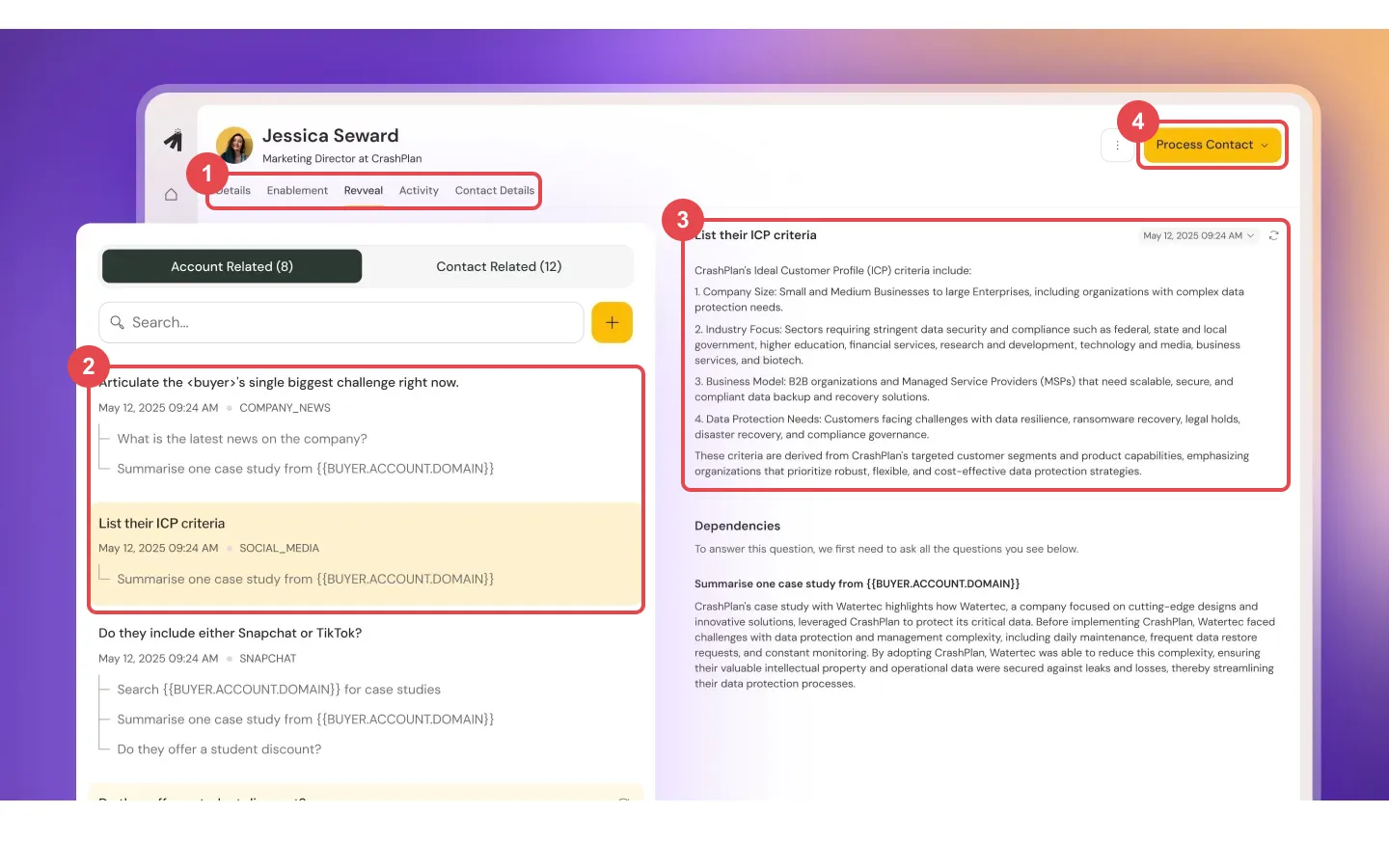
RevvedUp contact record for Jessica Seward with four numbered marks: the Revveal tab in the row of Details, Enablement, Activity and Contact Details tabs, the list of AI research questions, the AI answer listing the company's ICP criteria, and the existing Process Contact button
From Cieden's RevvedUp case study on cieden.com, with numbered marks added.
  1. Revveal is one more tab in the contact record, beside Details, Enablement and Activity, so users find the AI where they already work.
  2. The research questions are listed with their source type, so the user can see what the AI was asked.
  3. The answer opens next to the questions, with a Dependencies note under it showing which other questions it relied on.
  4. The existing Process Contact action stays where it was, so the AI adds context without moving the main task.
  • Inline. Fits when AI improves a decision users already make on a known screen. Cieden put RevvedUp's Revveal research in the contact record (above), Spaceberry added explanations beside Peoplelogic's metrics and Momentum Design Lab brought Sifted's recommendations onto the dashboard.
  • Side panel. Fits when users ask follow-up questions about what is on screen. Merge Rocks designed how Oleria Copilot's chat window appears inside the platform, with starter prompts such as a daily summary and a weekly security report.
  • Command bar. Fits when the AI can do many jobs across the product and users already know what they want. Bricx put an Ask Sybill bar above Sybill's meetings list for jobs like finding blockers or writing follow-ups.
  • Own module. Fits when AI runs multi-step work and a person reviews the output. Bricx designed Writesonic's AI agent screens, and Eleken gave Avid's recommendations a Playbook module of cards. More credited examples are in 10 B2B SaaS AI features and the agencies that designed them.

How do you add AI to a SaaS product without confusing existing users?

Quick answer: Build the feature around the moments users get stuck, show the reason or source next to each AI answer, and give the AI a look of its own that still matches the product.

Start from the moments users get stuck, not from the model. Eleken's interviews for Avid found four triggers, such as declining donor trends, and Playbook was built around those moments.

  • Show the reason next to the answer. RevvedUp's Revveal answers list the questions they depend on, Peoplelogic's metrics explain why engagement changed, and Sybill's screen tells users the AI may make mistakes. The agent UX guide covers the same trust problem for agents.
  • Let the AI look new without looking foreign. Merge Rocks gave Oleria Copilot a colour and gradient that still matched the platform, and Spaceberry built design system patterns for AI hints so they look the same on every screen. The AI onboarding patterns guide covers the first run.

How much does it cost to add AI to a SaaS product with a UX agency, and how long does it take?

Quick answer: Clutch minimums here run from $10,000 to $25,000, monthly plans start at $3,250, and published timelines run from 2 to 3 weeks for one flow to about three months for an AI-assisted dashboard redesign.

  • Clutch minimums here run from $10,000 (Merge Rocks, Cieden, Eleken, Spaceberry) to $25,000 (Momentum Design Lab), and Bricx projects start at $25,000.
  • Monthly models start lower: Spaceberry from $3,250 for 50 hours, Eleken from $4,599 for a half-time designer and Cieden from $7,200 per designer.
  • Merge Rocks puts its average monthly product design budget at $7,200.
  • Published timelines run from 2 to 3 weeks for one redesigned flow (Bricx) and design sprints of 1 to 4 weeks (Merge Rocks) to about three months for Spaceberry's Peoplelogic redesign.
  • The UX agency pricing guide covers wider market rates.

What else do buyers ask about UX agencies for adding AI to a SaaS product?

Which UI/UX agencies have experience with AI integration in SaaS products?

All six agencies here have a public case study of AI inside a live B2B product: Bricx (Sybill, Writesonic), Merge Rocks (Oleria Copilot), Cieden (RevvedUp), Eleken (Avid), Spaceberry (Peoplelogic) and Momentum Design Lab (Sifted).

Which agencies handle brand plus AI UX together?

Merge Rocks designed both the brand identity and the chat UI concepts for Oleria Copilot, including its colour, gradient and logo animation. Bricx covers brand, product UI and the front-end build in one team, and designed both the product and the site for Writesonic. Eleken applied Avid's existing brand across the platform while it designed the new AI module.

Does an AI feature in a SaaS product have to be a chatbot?

No. Of the case studies here, only Oleria Copilot is a chat interface. The others put AI inline: a research tab in RevvedUp's contact record, explanations beside Peoplelogic's metrics, recommendation cards in Avid's Playbook and insights on Sifted's dashboard.

How much does it cost to add an AI feature to an existing SaaS product with an agency?

Clutch minimums for the agencies on this page run from $10,000 to $25,000 per project. Monthly plans start at $3,250 for 50 hours at Spaceberry and $4,599 for a half-time designer at Eleken. Bricx projects start at $25,000.

How long does it take to design an AI feature for an existing product?

Bricx publishes 2 to 3 weeks to redesign one flow, and Merge Rocks runs design sprints of 1 to 4 weeks. Spaceberry's Peoplelogic redesign, AI explanations included, took about three months.

Can a design agency also build the AI feature?

Bricx builds the front end in React and Next.js, and Merge Rocks lists web development as a fifth of its Clutch work. Cieden, Eleken and Spaceberry design only and hand over files and a design system to your engineers.

Who maintains this ranking?

Written and maintained by the Top UX Design Agencies editorial team. Agencies are scored with the published methodology, facts come from each agency's Clutch profile and its own case studies, and errors can be reported through the corrections process. This page was last updated on November 19, 2026.

Related rankings

Go deeper: B2B SaaS AI features and who designed them ยท How to design for AI agents ยท AI onboarding patterns