




Top UX Design Agencies
Menu

Internal tools ยท Updated 2026

7 Best Agencies for Admin Panels and Internal Tools in 2026

The 7 best agencies for admin panels and internal tools in 2026 are Bricx, Creative Navy, Dworkz, CodeTheorem, Think Company, Qubstudio and Fuselab Creative.

For teams whose ops, support or finance staff live in a Django admin, a macro spreadsheet or a console nobody designed. These agencies build custom admin panels and internal tools quickly, design dense dashboard screens and handle back-office UX.

Each shows admin work in a public case study, and agencies that also write the front end rank higher.

Updated by the editorial team. No agency pays to be listed.

Table of contents
  1. TL;DR
  2. Shortlist by team and timeline
  3. Comparison table
  4. The 7 agencies
  5. Good admin screens
  6. Agency or Retool
  7. How we reviewed these agencies
  8. Cost and timelines
  9. FAQ

The short answer

The top agencies for admin panels and internal tools in 2026 are Bricx, Creative Navy and Dworkz. Bricx designs the product and builds it in React and Next.js, quoting 6 to 10 weeks for design and build together. Creative Navy designed Callsign's fraud policy engine for bank risk analysts in about six weeks. Dworkz redesigned PubNub's Administrator Dashboard and Kantola's training admin.

TL;DR: the best agency for each job

  • Best for an admin panel or internal tool designed and shipped in code: Bricx. Projects from $25,000; 6 to 10 weeks for design and build together; 2 to 4 weeks to build finished designs.
  • Best for a rules or configuration console used by expert analysts: Creative Navy. $5,000+ minimum (Clutch); about six weeks for Callsign, with front-end build from week four.
  • Best for redesigning an admin console customers already depend on: Dworkz. $10,000+ minimum (Clutch).
  • Best for a back-office redesign coded on a small budget: CodeTheorem. $1,000+ minimum (Clutch).
  • Best for enterprise operations moving off spreadsheets: Think Company. $50,000+ minimum (Clutch); three years embedded with the shipping operator.
  • Best for a multi-role back office redesign on time and materials: Qubstudio. $10,000+ minimum (Clutch); 1 year and ongoing for Workforce Velocity (time and materials).
  • Best for a real-time operations console with heavy data visualization: Fuselab Creative. $25,000+ minimum (Clutch); ten working days for a sprint that ends in a coded prototype.

Price and timeline signals checked on November 19, 2026 against each agency's Clutch profile and its own website.

Shortlist by team and timeline

Start from the row that matches your situation.

If you needLook atBecause
Our ops team works in five spreadsheets and an admin page the engineers built in a weekendBricx, Think CompanyBricx designs the replacement and builds it in React and Next.js. Think Company mapped the hidden spreadsheets behind a shipping operator's daily work.
Admins change hundreds of user records one row at a timeDworkz, CodeTheoremDworkz added bulk actions and status groups to Kantola's admin. CodeTheorem redesigned Emroll's HR back office and coded the front end.
Analysts configure rules, and every change has to be traceable for auditCreative NavyCreative Navy designed Callsign's fraud policy engine for bank analysts, with React engineers building from week four.
Dispatchers, approvers and admins all fight over the same screenQubstudioQubstudio rebuilt roles, navigation and search across Workforce Velocity's HR platform.
Our operators watch live data and need to drill into one node fastFuselab CreativeFuselab Creative designs operator consoles such as CyberDefend, with its developers working beside the designers.
We just raised, and the board wants the ops console live this quarterBricx, CodeTheoremBricx quotes 6 to 10 weeks for design and build together. CodeTheorem has the lowest Clutch minimum here, $1,000.
A budget of $10,000 or less to startCreative Navy, Dworkz, CodeTheorem, Qubstudio$1,000 minimum: CodeTheorem; $5,000 minimum: Creative Navy; $10,000 minimum: Dworkz and Qubstudio.
Something to review within about 4 weeksBricxBricx: 6 to 10 weeks for design and build together; 2 to 4 weeks to build finished designs.

Minimums from each agency's Clutch profile; monthly prices and timelines from each agency's own site, checked November 19, 2026.

Admin and internal tool agencies compared

7 Best Agencies for Admin Panels and Internal Tools in 2026: best for, SaaS case study, location, team size, minimum project and Clutch rating
#AgencyBest forData-dense UI shownSaaS case studyBased inTeam sizeMin projectClutch rating
1BricxSoftware teams that need an admin or internal tool designed and built in React and Next.jsSybill deal workspace with tasks, filters and archive viewSybill, an AI deal copilot for revenue teamsDubai, United Arab Emirates10 to 49 people$25,000+5.0 (32)
2Creative NavyExpert tools where analysts configure policies, rules or simulationsCallsign fraud policy engine for bank analystsCallsign, a fraud detection and authentication platformLondon, United Kingdom10 to 49 people$5,000+5.0 (54)
3DworkzB2B SaaS companies redesigning an existing admin or management consolePubNub admin dashboard; Kantola LMS adminKantola, a workplace training platformSan Francisco, United States10 to 49 people$10,000+4.9 (8)
4CodeTheoremStartups and small software companies that need a back office designed and builtEmroll HRMS and CRM back officeEmroll, HR and CRM softwareAhmedabad, India10 to 49 people$1,000+5.0 (9)
5Think CompanyEnterprise operations teams replacing paper and spreadsheets with one platformTerminal operations platform for a shipping operatorA global vehicle and heavy-equipment shipping operator (name withheld)Conshohocken, United States50 to 249 people$50,000+4.9 (18)
6QubstudioBack-office platforms where several roles share one interfaceWorkforce Velocity HR and payroll ERPWorkforce Velocity, an HR and workforce platformL'viv, Ukraine50 to 249 people$10,000+4.9 (92)
7Fuselab CreativeOperations and monitoring tools with live data and drill-downCyberDefend real-time operator consoleCyberDefend, a situational awareness platformTysons, United States10 to 49 people$25,000+5.0 (15)

Location, team size, minimum project and ratings come from each agency's Clutch profile, retrieved between August 24 and November 17, 2026.

1

Best agency for admin panels and internal tools that ship as React and Next.js code: Bricx
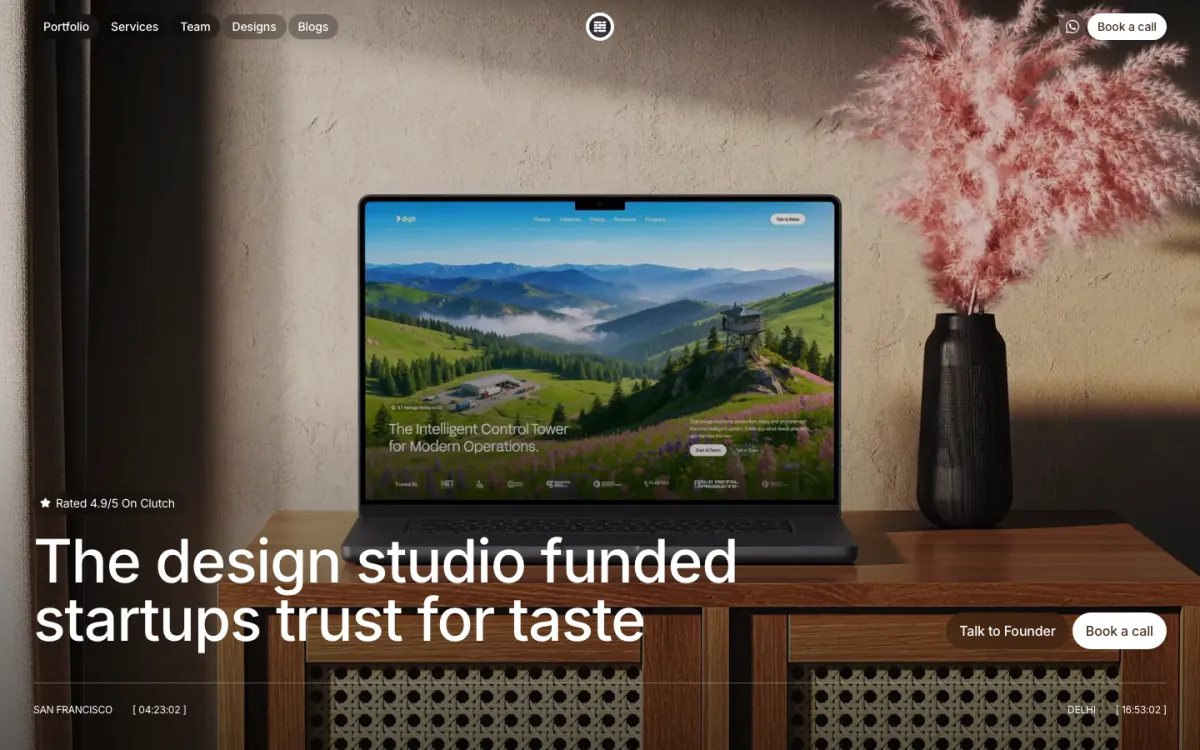
bricxlabs.com
Bricx website homepage

Why #1: Bricx designs the screens and writes the front end with the same people, so an internal tool goes from Figma to a working React and Next.js build without a handoff. It has the highest methodology score on this page (4.9 of 5) and a 5.0 Clutch rating across 32 reviews.

Covers
Product UI and UX, design systems, front-end engineering, SaaS websites, brand
Ideal client
Software companies only; startups and mid-market firms make up 90% of its Clutch clients
Clients
Sybill, Writesonic, Camb.ai, Hobbes, Digit
SaaS case study
Product design for Sybill, an AI deal copilot: CRM updates, call recaps and next steps pulled into one deal view that reps and managers both work from, with tasks, filters and a closed or archived view. Case study
Timeline
6 to 10 weeks for design and build together; 2 to 4 weeks to build finished designs Source
Based in
Dubai, United Arab Emirates
Team
10 to 49 people
Clutch
5.0 from 32 reviews
Min project
$25,000+
Not a fit for
Non-software businesses and budgets under $25,000.

Bricx works only with software companies, and its designers and engineers are the same people, so the file and the build stay in step.

In the Sybill case study, the problem was deal context spread across calls, email, Slack and the CRM, with reps updating fields by hand. Bricx designed one deal view that holds CRM updates, recaps and next steps, the kind of dense working screen an internal tool needs.

Builds run in React and Next.js on a ShadCN component base, with the component library made before the pages and something clickable every two weeks. Projects start at $25,000.
Visit BricxFull Bricx profileClutch reviews

2

Creative Navy

Expert tools where analysts configure policies, rules or simulations

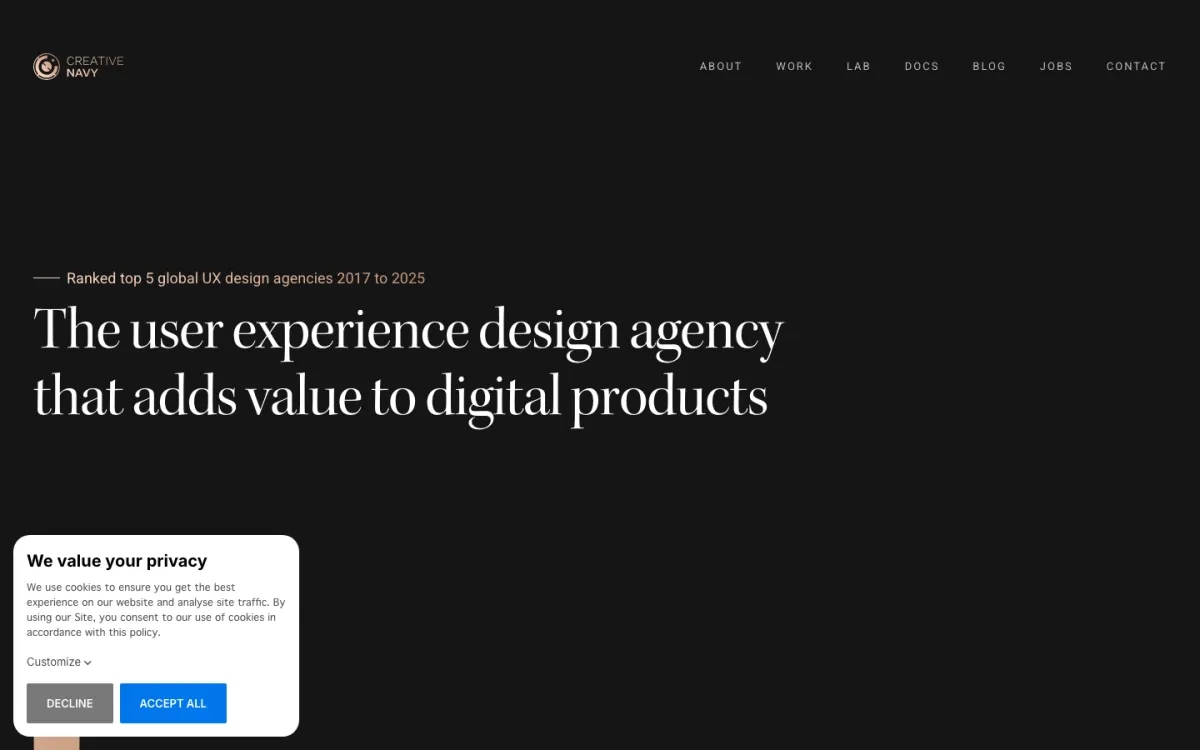
interface-design.co.uk
Creative Navy website homepage

Why #2: The pick when expert users configure rules inside the tool: Creative Navy turned Callsign's policy engine into something bank risk analysts could read and audit, and front-end engineers started building in React after about four weeks. It sits below Bricx because its Clutch work is all design, so your engineers or a React developer on the project write the code.

Covers
UX/UI design only (100% of its Clutch service mix)
Ideal client
Mid-market companies, 60% of its Clutch clients
Clients
Callsign, Gexcon, PwC
SaaS case study
Interaction architecture and a design system for Callsign's policy engine, which senior bank risk teams use to set how its fraud model reacts at login and payment. The team included a React developer and built D3 visualizations. Case study
Timeline
About six weeks for Callsign, with front-end build from week four Source
Based in
London, United Kingdom
Team
10 to 49 people
Clutch
5.0 from 54 reviews
Min project
$5,000+
Not a fit for
Teams that want brand and a marketing site from the same partner.

Creative Navy designs interfaces for technical and regulated software, and its case studies cover fraud analysts, simulation engineers and industrial displays.

In the Callsign case study, rules were scattered and conflicts were hard to see, and banks asked about traceability during demos. Creative Navy modelled how analysts reason about risk, then turned that into a configuration approach the team could build in React, with a design system the internal team could extend.

The Callsign work took around six weeks, and its Clutch minimum is $5,000.

Visit Creative NavyFull Creative Navy profileClutch reviews

3

Dworkz

B2B SaaS companies redesigning an existing admin or management console

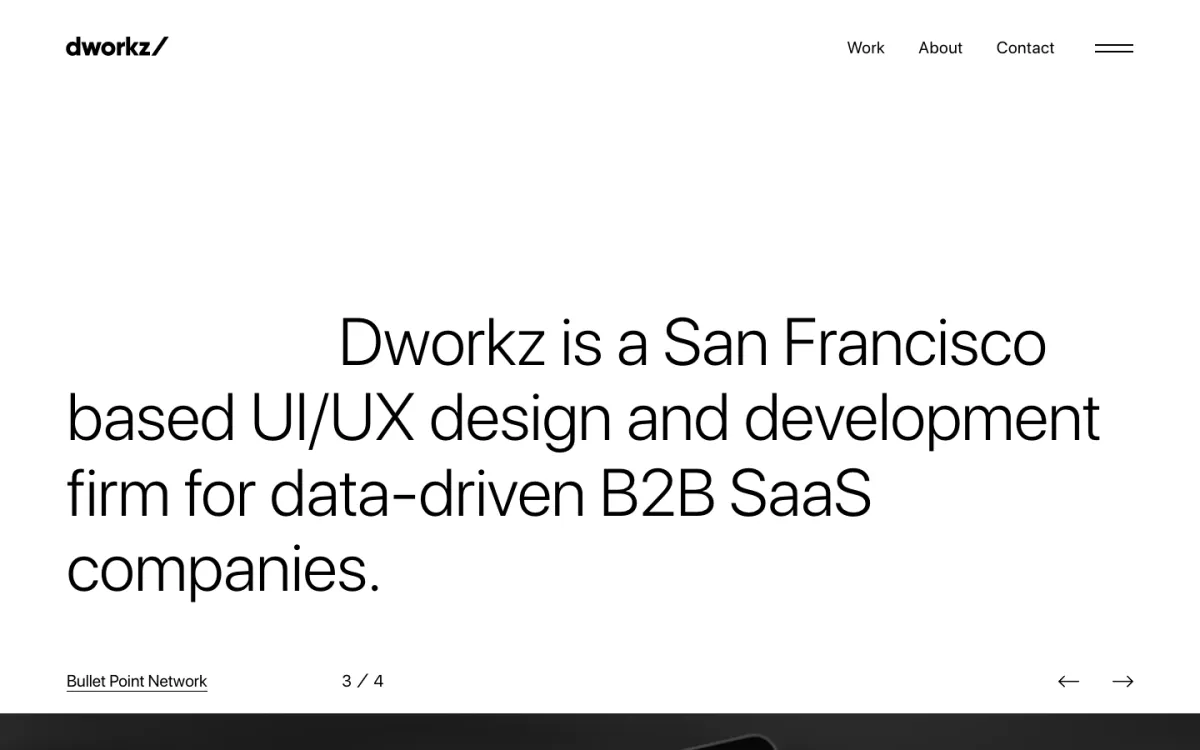
dworkz.com
Dworkz website homepage

Why #3: Dworkz has two public admin consoles, PubNub's Administrator Dashboard and Kantola's training admin, and it listed front-end development on Kantola. Its methodology score (4.2) is the lowest here, but no other pick shows as much admin work, so it ranks on fit.

Covers
UX/UI design 25%, custom software development 20%, web design 15%, plus low-code, mobile and web development
Ideal client
Mid-market and enterprise companies, 95% of its Clutch clients combined
Clients
PubNub, Kantola Training Solutions, LexisNexis, Check Point, SAP
SaaS case study
UX, UI and front-end development for Kantola's learning management system: status groups for training managers, a learner progress table and bulk user actions, keeping functionality built a decade earlier. The case study says customer satisfaction climbed to over 99% after release. Case study
Timeline
Not published on its site
Based in
San Francisco, United States
Team
10 to 49 people
Clutch
4.9 from 8 reviews
Min project
$10,000+
Not a fit for
Early-stage teams: startups are 5% of its Clutch clients.

Dworkz designs and develops software for B2B SaaS companies, and a fifth of its Clutch mix is custom software development.

For PubNub, it interviewed customers and rebuilt the Administrator Dashboard's navigation, keyset management, analytics and debug console. For Kantola, it hid repetitive controls until they were needed and gave training managers a view of every learner's status.

Its Clutch minimum is $10,000, and it publishes no timeline.

Visit DworkzFull Dworkz profileClutch reviews

Our rankingBuilding analytics dashboards for customers instead?See the agencies ranked for SaaS dashboard redesigns.See the ranking
4

CodeTheorem

Startups and small software companies that need a back office designed and built

codetheorem.co
CodeTheorem website homepage

Why #4: Fits a smaller budget that still needs the back office designed and coded: CodeTheorem's frontend team built the Emroll HR and CRM redesigns it designed. It sits below Dworkz because its public admin work covers one client.

Covers
UX/UI design 30%, web development 30%, web design 20%, custom software 10%, mobile 10%
Ideal client
Startups and small businesses, 60% of its Clutch clients
Clients
Emroll
SaaS case study
A redesign of Emroll HRMS, software for onboarding, leave, attendance, payroll, expenses and timesheets, from a workflow audit and interviews to a front end built by CodeTheorem's own developers. Case study
Timeline
Not published on its site
Based in
Ahmedabad, India
Team
10 to 49 people
Clutch
5.0 from 9 reviews
Min project
$1,000+
Not a fit for
Enterprise programs that need a large standing team.

CodeTheorem pairs product design with development, and web development is 30% of its Clutch mix.

In the Emroll HRMS case study, Emroll's HR software had grown from the founder's first version and was losing customers on usability. CodeTheorem audited the workflows, tested wireframes with users and handed the new design to its own frontend team, which did the same on Emroll's CRM.

The agency offers fixed-cost and monthly models, and its Clutch minimum is $1,000, the lowest on this page.

Visit CodeTheoremFull CodeTheorem profileClutch reviews

5

Think Company

Enterprise operations teams replacing paper and spreadsheets with one platform

thinkcompany.com
Think Company website homepage

Why #5: The right call when the internal tool sits on top of messy processes that nobody has mapped: Think Company spent three years inside a logistics operator's terminals and found the spreadsheets that ran the real work. Its $50,000 minimum and 65% enterprise client base put it below the faster, smaller builds above.

Covers
Product design 20%, UX/UI design 20%, custom software 10%, low-code development 10%, web design 10%
Ideal client
Enterprise companies, 65% of its Clutch clients
Clients
Merck
SaaS case study
Research across terminals and processing centers, a shared taxonomy for locations, services and cargo, and an embedded team for the move onto one platform, for an operator shipping vehicles and heavy equipment by sea. Case study
Timeline
Three years embedded with the shipping operator Source
Based in
Conshohocken, United States
Team
50 to 249 people
Clutch
4.9 from 18 reviews
Min project
$50,000+
Not a fit for
Startups and budgets under $50,000.

Think Company runs research, product design and build, and embeds its people in client teams.

In the shipping operator case study, each terminal described the same cargo differently and staff kept daily work in personal spreadsheets. Think Company mapped that work first, then built the shared vocabulary the new platform runs on.

Services on the case include enterprise platform engineering and team augmentation.

Visit Think CompanyFull Think Company profileClutch reviews

Our rankingWant the designers to write the code too?Compare design engineering studios that ship working SaaS prototypes.See the ranking
6

Qubstudio

Back-office platforms where several roles share one interface

qubstudio.com
Qubstudio website homepage

Why #6: Fits a back office with many user types: Qubstudio rebuilt roles, navigation and search in Workforce Velocity's HR platform without dropping features. It hands over designs, so it ranks below the agencies that also build.

Covers
UX/UI design only (100% of its Clutch service mix)
Ideal client
Enterprise companies, 50% of its Clutch clients, plus 40% mid-market
Clients
Workforce Velocity, BluePallet, Infrakit, Gulf Bank
SaaS case study
A redesign of Workforce Velocity's ERP for workforce planning, recruitment, payroll and timekeeping: new navigation and search, new roles, and a simpler way to assign sets of users their access. Case study
Timeline
1 year and ongoing for Workforce Velocity (time and materials) Source
Based in
L'viv, Ukraine
Team
50 to 249 people
Clutch
4.9 from 92 reviews
Min project
$10,000+
Not a fit for
Teams that need the front end coded by the same partner.

Qubstudio is a product design studio, and enterprise firms are half of its Clutch clients.

On Workforce Velocity, the brief was to overhaul a complex ERP without disrupting existing workflows. A product designer, business analyst and project manager ran discovery and user interviews, then shipped changes gradually with feedback from real users.

Its enterprise UX work is written for interfaces that dispatchers, admins, approvers and auditors share.

Visit QubstudioFull Qubstudio profileQubstudio vs BricxClutch reviews

7

Fuselab Creative

Operations and monitoring tools with live data and drill-down

fuselabcreative.com
Fuselab Creative website homepage

Why #7: The pick for operational consoles where staff watch live data and drill into one asset. It ranks last because its public work leans toward monitoring dashboards and data visualization more than back-office admin screens.

Covers
UX/UI design 50%, custom software 15%, product design 15%, AI development 10%
Ideal client
Mid-market companies, 60% of its Clutch clients
Clients
Corelight, Avison Young, EY
SaaS case study
Dashboard design for CyberDefend, a platform where operators track satellite health, network load and traffic anomalies in one interface and zoom into a single node to find the cause of an issue. Case study
Timeline
Ten working days for a sprint that ends in a coded prototype Source
Based in
Tysons, United States
Team
10 to 49 people
Clutch
5.0 from 15 reviews
Min project
$25,000+
Not a fit for
Simple CRUD admin screens with little data visualization.

Fuselab Creative specializes in dashboards and data visualization, and 15% of its Clutch mix is custom software development.

CyberDefend pulls event insights, a network heatmap, health indicators and traffic flow into one operator view. Its dashboard development service pairs designers with developers through the whole process.

Its Clutch minimum is $25,000.

Visit Fuselab CreativeFull Fuselab Creative profileFuselab Creative vs BricxClutch reviews

How we reviewed these agencies

Quick answer: every agency here has a Clutch profile and a public case study on its own site, and the order weighs fit for this page's buyer first and the published methodology score second.

We reviewed each agency on internal and operational software: admin consoles, back offices, configuration tools and data-dense screens staff use every day. Every pick shows that work in a public case study on its own site that names or plainly describes the client.

Each also has a live Clutch profile and a place in the full ranking of UX design agencies. Order follows fit for a tool that has to ship quickly, which favors agencies that also write the front end, then the methodology score. Numbers appear only where the agency's own page states them.

Order weighs fit for this page's buyer first and the site's published methodology score second (design taste 35%, B2B and SaaS focus 30%, client-reported results 20%, senior team depth 15%). Each card says why the agency sits where it does.

What a good admin screen gets right

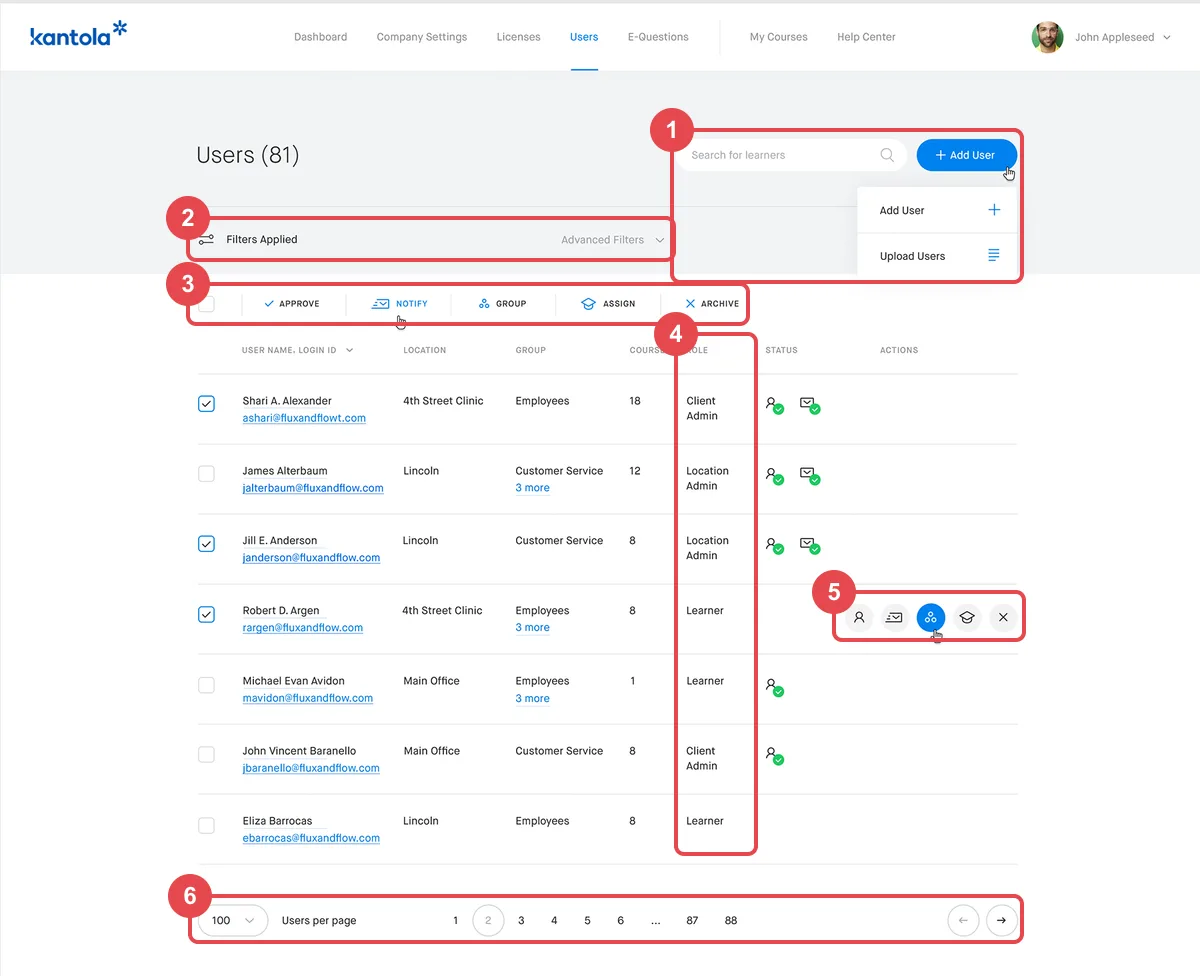
Quick answer: A good admin screen lets one person find, filter and change many records at once and shows each user's role in the table, as the Kantola users screen Dworkz designed does.

Kantola's Users admin screen designed by Dworkz, with six numbered markers on search and add user, filters, the bulk action bar, the role column, row actions and pagination
Kantola's Users screen, from Dworkz's public case study.
  1. Search sits next to Add User and Upload Users, so an admin can find one person or import a whole list from the same spot.
  2. Filters stay applied above the table, with an Advanced Filters drawer for narrower cuts.
  3. One bulk action bar (Approve, Notify, Group, Assign, Archive) acts on every checked row at once.
  4. A Role column shows Client Admin, Location Admin or Learner, so permissions are visible without opening each record.
  5. Row actions appear on the row being worked, which keeps repeated controls out of sight until they are needed.
  6. Page size and pagination let an admin show 100 users at a time.

Two things this screen leaves out matter as much on most internal tools. Keyboard shortcuts let staff who process records all day move through a queue without the mouse, and an audit log shows who changed what and when. Callsign's bank customers asked about traceability and audit trails during demos, which is why Creative Navy designed the policy engine around them.

Admin screens are a different job from the analytics dashboards end users see. For those, see the SaaS dashboard redesign agencies.

Should you build internal tools with an agency or a low-code tool like Retool?

Quick answer: A low-code builder such as Retool suits internal staff who need standard tables and forms on existing databases, and an agency suits tools with many roles, customer-facing admins or workflows that need their own UX and front-end code.

Retool builds, deploys and manages internal tools on top of any database, API or LLM. That is a fast route when the users are your own staff and the screens are lists, forms and approvals over data you already have.

An agency is worth it when the admin panel is part of the product your customers log into (as PubNub's Administrator Dashboard is), when several roles share one interface, or when the workflow is complex enough to need research first. Bricx, Dworkz and CodeTheorem also write the front end, and the design engineering agencies for SaaS prototypes page compares more studios that do. Many teams start an internal tool in a builder, then hire design help once it has users who complain, and a short audit of the workflow tells you whether the fix is new screens or a new tool.

How much does an agency charge to design and build an admin panel, and how long does it take?

Quick answer: Clutch minimums on this list run from $1,000 to $50,000, Bricx projects start at $25,000, and published timelines run from ten working days for a coded prototype to engagements of a year or more.

  • Clutch minimums here run from $1,000 (CodeTheorem) and $5,000 (Creative Navy) to $50,000 (Think Company).
  • Dworkz and Qubstudio start at $10,000, Fuselab Creative at $25,000, and Bricx projects start at $25,000.
  • Fuselab Creative's own site also lists a two-week Figma Prototype tier at $14,999.
  • Short engagements: ten working days for a coded prototype (Fuselab Creative), about six weeks for Callsign's policy engine (Creative Navy) and 6 to 10 weeks for design and build together (Bricx).
  • Long programs: a year and ongoing for Workforce Velocity (Qubstudio) and three years with the shipping operator (Think Company). The UX agency pricing guide has more detail on how agencies price.

What else do buyers ask about agencies for admin panels and internal tools?

What are the best agencies for building custom admin panels and internal tools quickly?

Bricx, Creative Navy and Dworkz rank highest on this list. Bricx designs and builds in React and Next.js and quotes 6 to 10 weeks for design and build together. Creative Navy designed Callsign's policy engine in about six weeks, with front-end build starting at week four. Dworkz designed and developed Kantola's training admin.

Which dashboard design agency is best for admin panels with dense information?

For admin and back-office screens, Dworkz (PubNub, Kantola), Qubstudio (Workforce Velocity) and Creative Navy (Callsign) show the most relevant public work. Fuselab Creative fits real-time operations consoles with heavy data visualization. Bricx fits teams that want the dense screens designed and coded by one team.

What does a back office UX design agency do?

It designs the software staff use to run the business, such as HR, billing, approvals, user management and configuration. The work usually starts with mapping how people actually do the job, including the spreadsheets they keep on the side, as Think Company did for a shipping operator, then moves to roles, navigation, tables and bulk actions.

How much does it cost to have an agency build an internal tool?

Clutch minimums for the agencies here run from $1,000 at CodeTheorem to $50,000 at Think Company. Bricx projects start at $25,000. The total depends on how many roles and workflows the tool covers and whether the agency also writes the front end.

How long does it take an agency to design and build an admin panel?

Bricx quotes 2 to 4 weeks to build from finished designs and 6 to 10 weeks for design and build together. Creative Navy's Callsign work took about six weeks. Larger back-office programs run longer: Qubstudio's Workforce Velocity work has run for a year.

Is an admin panel the same as a SaaS analytics dashboard?

No. An analytics dashboard helps end users read their data, while an admin panel helps staff or account admins act on records: users, permissions, settings and approvals. Many products need both, and the agencies differ. The SaaS dashboard redesign agencies page covers the first job.

Who maintains this ranking?

Written and maintained by the Top UX Design Agencies editorial team. Agencies are scored with the published methodology, facts come from each agency's Clutch profile and its own case studies, and errors can be reported through the corrections process. This page was last updated on November 19, 2026.

Related rankings

Go deeper: Information architecture for complex products ยท What a design system is and what it should contain ยท How to hire a UX design agency